
agent-ship.dev · Docs · PyPI · Source
An agent is a prompt, a model and a few tools. Getting it in front of users is everything else: a REST API, session storage, streaming, tracing that reports real token costs, packaging.
AgentShip is that part. You write the agent as a short spec, and it handles serving, memory and observability. It integrates what you already use instead of reimplementing it — LangGraph runs the graph, LiteLLM handles models, MCP supplies tools, OpenTelemetry carries traces.
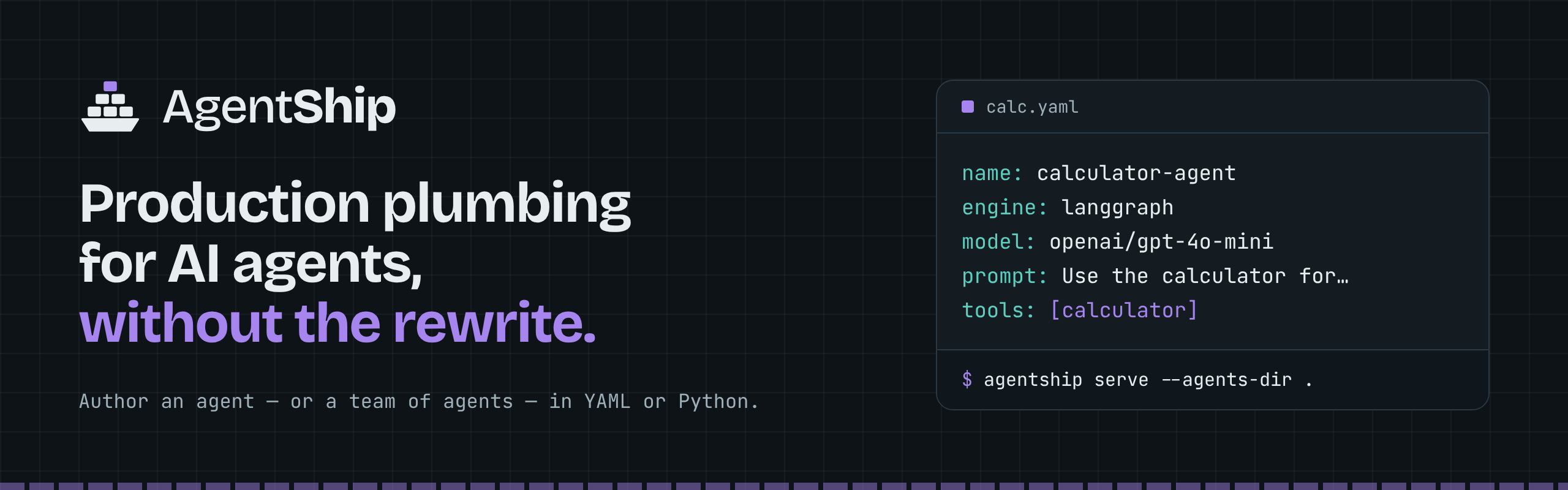
# calc.yaml
name: calculator-agent
engine: langgraph
model: openai/gpt-4o-mini
prompt: Use the calculator for arithmetic. Answer with just the number.
tools: [calculator]
pip install "agentship-sdk[starter,observability]"
agentship run calc.yaml --input "What is 17 times 23?"
agentship serve --agents-dir . # /v1 REST + SSE + WebSocket, and Studio at /studioNo API key yet? The echo engine runs offline with no provider, so the transports, auth, error
model and Studio are all explorable for free.
| agent-ship | The framework — spec, kernel, engines, the /v1 service, CLI and tracing. The runnable demo lives on its v1-demo branch. |
| agentship-webapp | The site behind agent-ship.dev. |
Seven distributions, released together on one version: agentship-sdk, -core, -langgraph,
-service, -observability, -cli and -voice. Install only what you need.
agentship-core imports no vendor library — that is what keeps the seams honest.
Every engine declares its capabilities, and agentship verify runs an engine-by-capability grid
that fails the build when a declared capability is not actually held. It is the rule the project
holds itself to, so the same rule applies here:
Built today — multi-agent teams, tools and MCP over stdio or streamable HTTP, short-term
memory with PostgreSQL checkpoints and human-in-the-loop resume, OpenTelemetry span trees with
token counts and costs (exporting to Phoenix, Langfuse, Opik or LangSmith), REST/SSE/WebSocket
serving with API-key or JWT auth and per-tenant isolation, a chat and trace UI at /studio, and
voice.
Not built — long-term memory, guardrails and PII, sandboxing, evals, and the Pydantic AI and Google ADK engine adapters. These are on the roadmap, not in the tree; please do not plan around them.
Early, on the 0.x line — the API can change between minor versions. Pin exactly if that matters
to you. The current release is 0.0.4; 0.0.1 is yanked, so a plain pip install gets a working
one. Python 3.13+.
Issues and pull requests are welcome on agent-ship — start with its CONTRIBUTING.md and code of conduct.
Licensed under Apache 2.0. The AgentShip name and logo are project trademarks, which Apache 2.0 does not grant rights in — see branding.