


A multi-agent web harvesting system built from the ground up on LangGraph's Supervisor pattern. Not a crawler that hands every page to an LLM — a deterministic-first pipeline where 9 specialist agents (scout → navigate → fetch/extract → evaluate → media → store) automate the full lifecycle of a site, and the LLM is an enhancer, never a dependency: every node has a fallback that runs without the model.
Table of Contents
Most "AI crawlers" are thin wrappers that call an LLM on every page — slow, expensive, and they stall the moment the model endpoint hiccups. I wanted to answer the production questions:
- How do you keep a 500-page crawl down to 3 LLM calls?
- How do you survive an LLM endpoint outage mid-run without losing the crawl?
- How do you measure "did this change help" instead of guessing?
- How do you take over autonomously when deterministic extraction fails?
This project is my answer: a supervisor graph with plan-and-execute and a review loop, backed by a run-level circuit breaker, batched post-hoc rescue, budget-triggered working-memory compaction, an offline golden-set evaluation, and 302 unit tests.
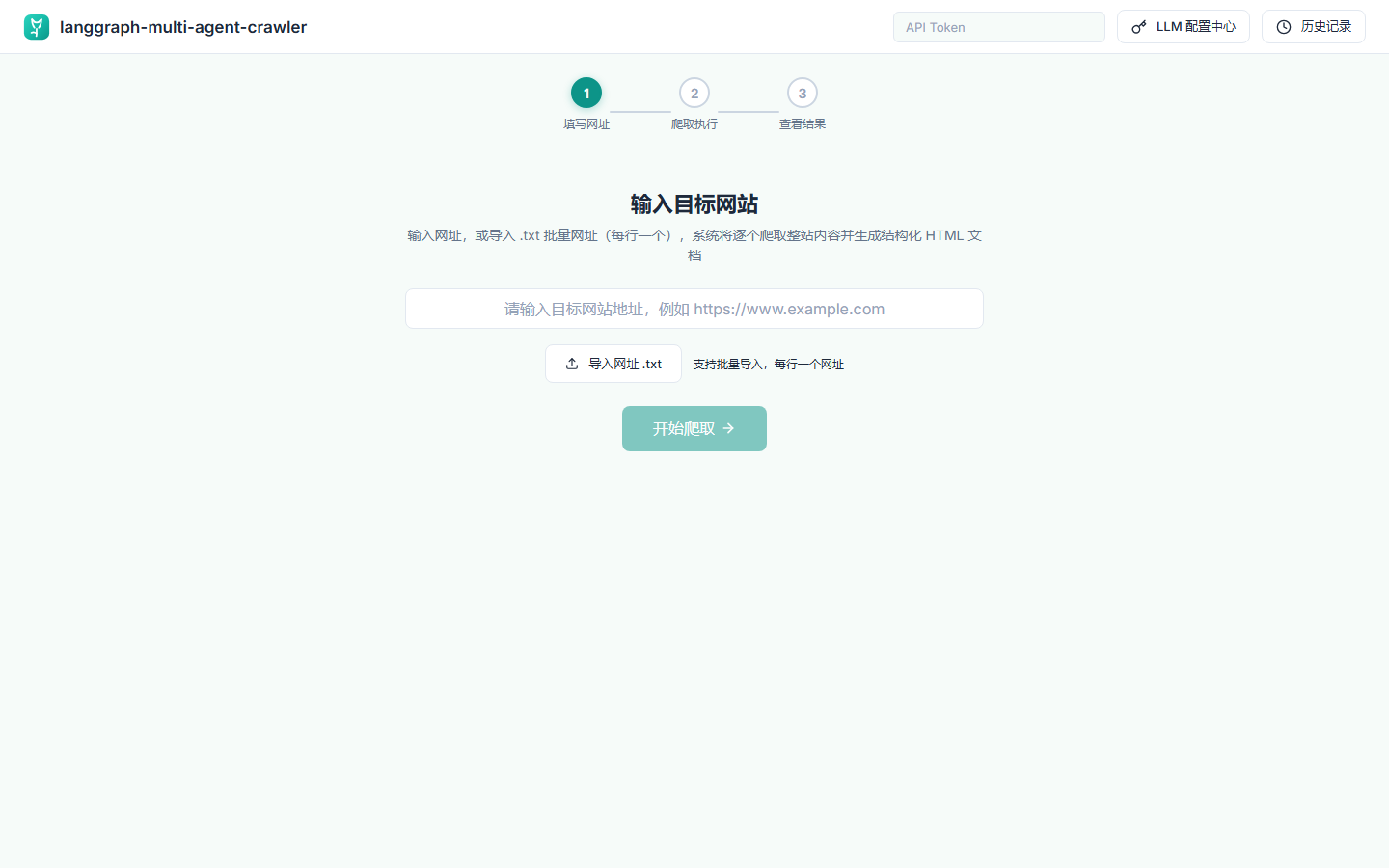
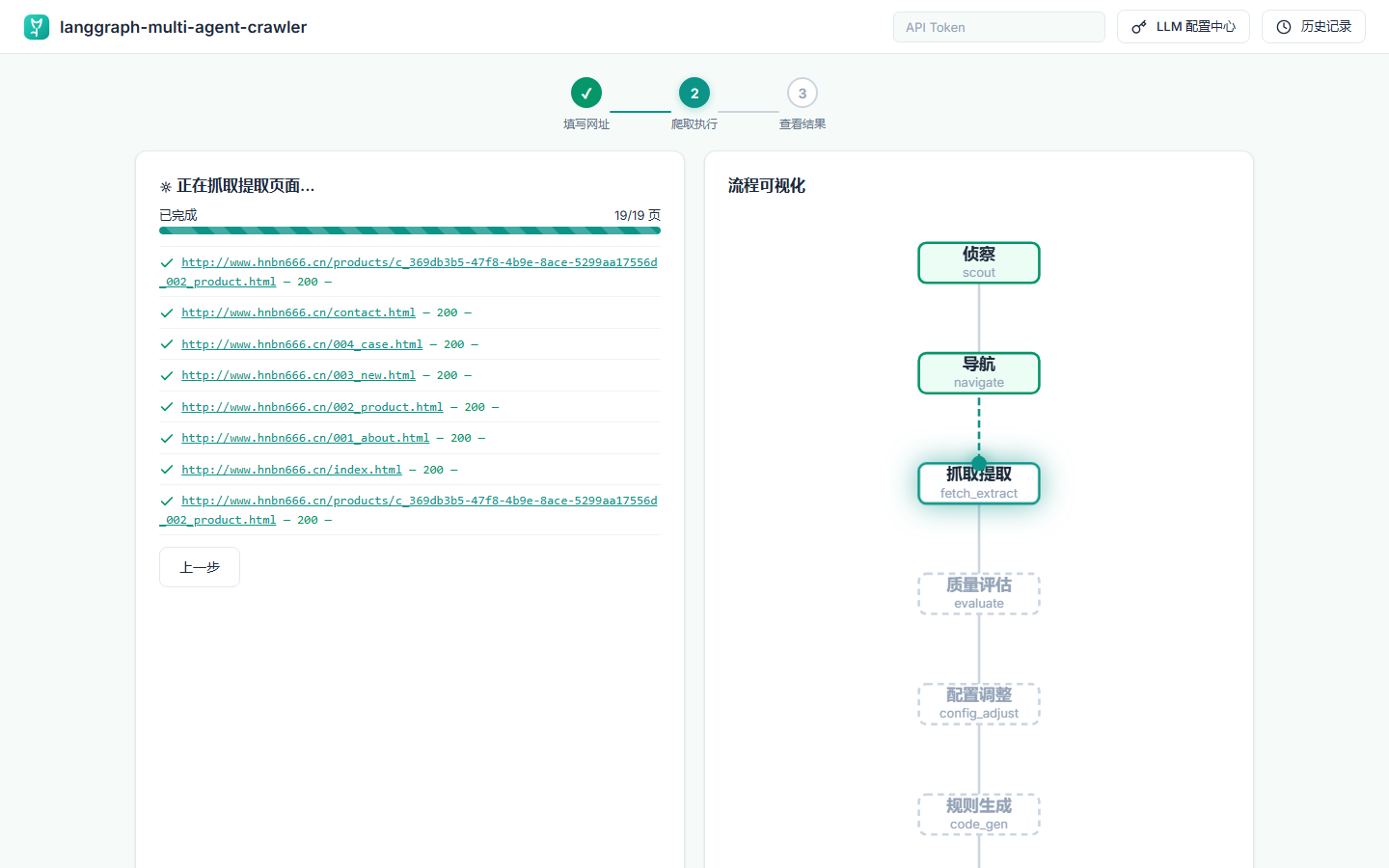
A real crawl of hnbn666.cn (RuiQiCMS visual-builder template) through the web workbench:
| Step 1 · Enter the target URL — one-click start | Step 2 · Crawl console — SSE live progress + DAG visualization |
|---|---|
 |
 |
graph LR
    S([START]) --> Scout[ScoutAgent]
    Scout --> Nav[NavigateAgent]
    Nav --> FE[FetchExtractAgent]
    FE --> RF{queue empty?}
    RF -- "no · BFS loop" --> FE
    RF -- "yes" --> Ev[EvaluateAgent]
    Ev --> RE{passed?}
    RE -- "yes / give up" --> Media[MediaProcessorAgent]
    RE -- "adjust < 3" --> CA[ConfigAdjustAgent]
    RE -- "adjust ≥ 3 · no rules yet" --> CG[CodeGenAgent]
    RE -- "rules exist · deep failure" --> RT[ReactTakeoverAgent]
    RE -- "error" --> St[StorageAgent]
    CA --> Nav
    CG --> Nav
    RT -- "retry" --> Nav
    RT -- "give up" --> Media
    Media --> St
    St --> E([END])
9 orchestrated agents (graph/agents.py, unified BaseAgent template method — trace recording, exception isolation, timing):
| Agent | Responsibility | LLM |
|---|---|---|
| ScoutAgent | analyze seed site → site profile + initial plan | no |
| NavigateAgent | extract navigation → fill BFS queue + section list | optional (classify) |
| FetchExtractAgent | fetch + rule-based cleaning + persist (deterministic first) | deep-degrade only |
| EvaluateAgent | quality gate + plan-completion check → adjudicate next step | yes (heuristic veto) |
| ConfigAdjustAgent | apply eval-driven config changes, re-crawl (≤3 times) | no |
| CodeGenAgent | LLM generates site-specific CSS-selector rules | yes |
| ReactTakeoverAgent | ReAct takeover when the deterministic chain fully fails | yes |
| MediaProcessorAgent | image filtering (decor/qr) + externalize + global dedup | no |
| StorageAgent | CSV persist + site-pattern memory write | no |
- Run-level LLM circuit breaker (
agents/breaker.py) — both LLM entry points share one breaker: 3 consecutive exhausted-retry failures fast-fail every later call in the run (callers degrade instead of waiting on timeouts); a single success resets; reset at run start. The breaker blocks only the LLM, never the crawl. - Batched post-hoc rescue — the BFS hot path runs at zero LLM (selector locate reads a SQLite-persisted cache, heuristic fallback otherwise). Under-par pages go to a rescue queue and are grouped by URL template (path digit →
{N}), so one LLM call locates the selector for a whole section. When the LLM is down, pages are saved degraded rather than dropped. - Multi-provider failover + SSE streaming (
agents/llm_pipeline.py) —chat_json/chat_streamswitch toLLM_BACKUP_BASE_URLSonce the primary exhausts retries, all under the same run-level breaker. Streaming output is also exposed as a/chat/streamSSE endpoint. - Budget-triggered working-memory compaction (
agents/react.py) — conversation history is working memory; when the estimated token budget is exceeded, keepsystem+ recent reasoning frames and fold the rest into one summary: LLM summarizer first, a rule summarizer as fallback (compaction never crashes; the event is traced asevent=context_compact).
- Offline golden-set harness (
tools/golden_check.py) — 3 template sites (portal / ecommercebooks.toscrape/ paged listquotes.toscrape), P/R/F1 with a conservativeoverlap = min(saved, expected)accounting plus section-recall,--jsonmachine-readable output. - Task success rate — end-to-end binary verdict per task:
success = ok and budget_ok, where quality assertions and LLM cost both must pass. A task that is content-perfect but blows the LLM budget is a failure — the acceptance criterion of a production agent. - Regression diff in CI (
tools/compare_runs.py) — full-metric diff between two golden reports; any primary metric worse →REGRESSION(exit 1, CI-gateable), all equal →SAME. - LLM-as-judge (
agents/eval.py) —judge_agreementcomputes Cohen's kappa between human labels and LLM verdicts (calibration tooling, not a runtime score).
- Three-layer prompt-injection defense (
agents/safety.py) — untrusted HTML wrapped with an explicit "data, not instructions" declaration; strict Pydantic output schemas (parse failure → heuristic degrade); conflict veto (LLM says pass but heuristics strongly disagree → downgraded). - Compliance & transport safety (
agents/fetcher.py) — robots.txt check on by default (stdlibrobotparser, zero new dependencies, per-domain parser cache, missing/network-failure → allow, blocked URLs markedblocked_by_robots); TLS verification on by default (CRAWLER_TLS_VERIFYfor explicit exemption); self-imposed frequency limiting (human-pace delay + concurrency semaphore). - Cross-run site memory (
memory.py) —site_patternswrites site type / JS-render / template hints after a successful crawl; a second crawl of the same site hits the memory and skips re-reconnaissance (cold → warm start, 100% hit rate measured). - Full trace observability — every agent's input digest / decision / output / duration lands in JSONL (
output/<netloc>/traces/), events cover start/end/error/decision/plan/review/memory_hit/store. - Lightweight RAG (
agents/semdedup.py+agents/vector_retriever.py) — character-level n-gram Jaccard near-duplicate detection (no tokenizer/vector DB), plus a zero-dependency TF-IDF cosine retriever over harvested pages with two-stage reranking (pseudo-relevance-feedback query expansion + score fusion), scored with Recall@k / NDCG@k. - MCP integration (
tools/mcp_server.py+tools/mcp_client.py) — action/analysis tools exposed as MCP stdio tools (protocol 2025-11-25), single-source executors shared with the in-process function-calling path; fail-closed error channel. - FastAPI service (
api/server.py) —POST /crawl(202 / 409 single-slot busy / 429 throttled),GET /tasks/{id},GET /tasks/{id}/results; X-API-Key auth, per-client submit throttling, Dockerfile. The service layer holds zero business logic — CLI, desktop GUI, and REST share onerun_langgraph_crawlerentry (three shells, one core). - Lightweight distributed scheduler (
distributed/) — stdlib SQLite task queue + multiprocessing workers, zero new dependencies:BEGIN IMMEDIATEatomic claim, lease + heartbeat + crash recovery, attempts-bounded retry. Shard dimension is the site (each worker runs one site's full workflow). Batch-ran 3 real sites with 2 workers to{'done': 3},attempts=1each — exactly-once.
| Layer | Technology |
|---|---|
| Runtime | Python 3.11 · asyncio (semaphore throttling) |
| Orchestration | LangGraph (StateGraph + TypedDict State + Reducers) |
| LLM | langchain-openai (DeepSeek-compatible endpoint) + multi-provider failover |
| Fetch | httpx / requests · Playwright (JS-render fallback) · stealth header set |
| Parse & clean | BeautifulSoup4 · trafilatura · custom rule engine |
| Data | Pydantic v2 · SQLite (dedup / HTML cache / site memory) · CSV / files |
| Service | FastAPI · SSE · Docker |
| Quality | pytest (302) · JSONL traces · golden-set eval · LLM-as-judge · CI |
pip install -r requirements.txt
playwright install chromium          # only for JS-rendered template sites

# CLI crawl
python -c "import asyncio; from graph.workflow import run_crawler; asyncio.run(run_crawler('https://example.com', max_steps=3000))"

# Unit tests
python -m pytest tests -q            # 302 passed

# MCP stdio round-trip (handshake → tool discovery → call_tool → error channel)
python tools/mcp_client.py https://example.com/

# REST service (submit / progress / results + API key + throttling)
uvicorn api.server:app --host 0.0.0.0 --port 8000
curl -X POST localhost:8000/crawl -H "Content-Type: application/json" \
     -d '{"url": "https://example.com/", "concurrency": 5}'

# Lightweight distributed scheduler (SQLite queue + multiprocessing workers)
python distributed/scheduler.py enqueue urls.txt
python distributed/scheduler.py run-workers --workers 2
python distributed/scheduler.py status

# Offline static check (self-built stdlib checker; ruff cross-verifies in CI)
python tools/static_check.py         # 64 files / 0 issues

# Golden offline eval (P/R/F1 + section recall, --json machine-readable)
python tools/golden_check.py --offline --json

# Project metrics report (offline: golden metrics + real-site stats + eval-loop traces)
python tools/gen_metrics_report.py   # → reports/metrics_report.{md,json}

# Regression diff (full-metric, REGRESSION → exit 1)
python tools/compare_runs.py baseline.json current.json

# Lightweight RAG demo (index harvested HTML + semantic query)
python tools/rag_demo.py hnbn666
Desktop GUI (tkinter): python site_crawler_gui.py (batch URL import from TXT + platform/API-key config + per-site crawl).
├── agents/          # capability agents + safety layer + tool registry + budget
│                    #   + react (FC loop) + semdedup + vector_retriever + eval
├── graph/           # orchestration: workflow (Supervisor) / agents (9) / nodes / state
│                    #   + react_takeover (deep-degradation ReAct takeover)
├── tests/           # 302 unit tests (safety / plan / tools / ReAct / budgeting /
│                    #   dedup / RAG / eval metrics / FC eval path / graph smoke /
│                    #   golden loop / regression / takeover / breaker+rescue /
│                    #   MCP / API / distributed queue)
├── api/             # FastAPI service (server.py: submit/progress/results)
├── distributed/     # SQLite task queue + multiprocessing scheduler
├── tools/           # golden_check / compare_runs / static_check / check_links /
│                    #   rag_demo / analyze_trace / mcp_server + mcp_client /
│                    #   gen_metrics_report
├── reports/         # metrics_report.{md,json} — offline quantified evidence
├── memory.py        # SQLite long-term memory (visited_urls / site_patterns)
├── schemas.py       # Pydantic models + logging
├── .github/         # CI (multi-version Python: pytest + static check + golden)
└── main.py          # CLI entry
302 unit tests, all green. Every subsystem has dedicated coverage: safety (injection defense), plan-and-execute, BaseAgent template, tool layer + tool-arg sanitization, ReAct loop, token budgeting, compaction (8 cases: trigger boundary / system+recent-frame retention / summary fallback / loop convergence), Jaccard dedup, RAG retrieval metrics + two-stage reranking, trace-analysis (token/cost + agent success rate), eval metrics, FC evaluation path, graph assembly smoke, core decision routing (all 13 branches of the three supervisor adjudication functions), golden regression loop, deep-degradation takeover, circuit breaker + batched rescue, MCP tool layer, API service layer (incl. SSE), and the distributed queue with multiprocessing consumption.
python -m pytest tests -q            # 302 passed
python tools/static_check.py         # 64 files / 0 issues (self-built checker, ruff-verified in CI)
python tools/check_links.py          # markdown relative links (screenshots / docs)
The CI pipeline (.github/workflows/ci.yml) runs pytest + coverage, the double static check, golden verification, and (advisory) mypy on every push.
Coverage, honestly: the CI gate is 30% (~35% measured on the 3.12 leg). The 302 tests concentrate on the agent behavior layer (safety / ReAct / budgeting / breaker / compaction / eval metrics) plus the tool, API and queue layers; the 5.4k-line orchestration module graph/nodes.py is backed by the graph smoke test and the golden end-to-end eval, with unit-level routing tests being added incrementally. I care more about stating exactly what is tested and what backs the rest than about inflating the number.
Every node's default action runs without the model: site-type rules, link density, body length, MD5 dedup, Jaccard near-dup. The LLM only enters at judgment points (evaluate, rule generation, nav classification, deep-degrade) under a semaphore. Each LLM failure degrades back to the deterministic path — selector → code heuristics, classify → rule-based nav, clean → original body. Trade-off: deterministic rules never cover the long tail (WYSIWYG builders, weird templates) — accepted because the deep-degradation ReAct agent covers exactly that tail.
The conversation history inside the FC loop is working memory; correct decisions live in structured CrawlerState, so folding old reasoning frames into one summary loses only process frames, never state. When the token budget is exceeded: keep system + recent frames, fold the rest into one summary — LLM summarizer first, a rule summarizer (keeps tool names + success/failure truthfully) as fallback. Trade-off: the summary drops intermediate reasoning — accepted because state, not prose, carries correctness; the event is traced for audit.
Threshold of 3 consecutive exhausted-retry failures, reset on a single success, reset at run start (so GUI multi-site runs don't pollute each other). No half-open state and no reset on a timer — documented as a deliberate simplification ("this is not an industrial-grade breaker"). Trade-off: after a trip, the LLM stays down for the rest of the run — accepted because callers degrade to deterministic paths, and the crawl (not the LLM) is the product.
An earlier design located the content selector per page on the BFS hot path — when the internal endpoint was half-dead, single pages timed out 30–60s and stalled the whole site overnight. Fix: zero-LLM hot path (persisted selector cache) + a rescue queue grouped by URL template, one LLM call per section. Trade-off: rescue is deferred to the evaluate stage instead of being immediate — accepted because content already paid the fetch cost and is never dropped, even when the LLM is fully down (degraded save + status tags).
Compliance and transport security default to safe: robots.txt checked before every fetch (stdlib robotparser, per-domain parser cache, missing/failure → allow), TLS verification on. Trade-off: a strict robots.txt can legitimately block a crawl, and self-signed intranet certs break fetching — accepted with explicit escape hatches (CRAWLER_RESPECT_ROBOTS=false, CRAWLER_TLS_VERIFY=false): default safe, explicit exception.
The workload is tens of sites; the bottleneck is site I/O, not queue throughput. A BEGIN IMMEDIATE write lock is enough mutual exclusion for N workers, and SQLite means zero new infrastructure and zero ops. Trade-off: single-node horizontal scale only — accepted because the shard dimension is the site (each worker runs one site's whole workflow), and cross-process LangGraph state is architecturally unsupported anyway.
Claiming is atomic (BEGIN IMMEDIATE), so N workers never double-grab a task; leases expire and stale tasks are requeued (at-least-once), and attempts are bounded (fail → retry until cap → terminal failed). Measured: 3 sites × 2 workers → {'done': 3}, attempts=1 each. Trade-off: a lease is a timeout, not a lock — a crashed worker's task is redone, which is the accepted at-least-once semantic dressed in exactly-once measurement.
FunctionCallingLoop is the in-process LLM→tool protocol; MCP is the cross-process/cross-vendor standard (JSON-RPC over stdio). Both call the same executors (fetch_page / apply_config / quality_judge) — one implementation serves three paths (in-process FC, ReAct takeover, MCP client). Trade-off: the MCP layer adds protocol overhead — accepted because composability with any MCP client (Claude Desktop, Cursor, custom agents) beats micro-optimizing the boundary.
Measured results (offline-reproducible via python tools/gen_metrics_report.py): 8 real sites / 236 pages harvested; golden offline eval on hnbn666 (RuiQiCMS visual-builder template) = PASS with P/R/F1 0.60/1.00/0.75; 302 tests all green. Development milestones (CHANGELOG): a full crawl of zztzmjg.com went from stalled overnight at 86 pages to 85 seconds with 3 LLM calls via the circuit breaker + batched rescue; evaluation loops fired 12 config adjustments across 4 runs (saved 1→98 on xnjzgc.cn); the site-memory warm start hit 100%; the distributed scheduler ran 3 sites × 2 workers exactly-once.