






I build tools for investing decisions: portfolio construction, backtesting, risk simulation and valuation.
Every number shows its assumptions, and every projection says what it is not.


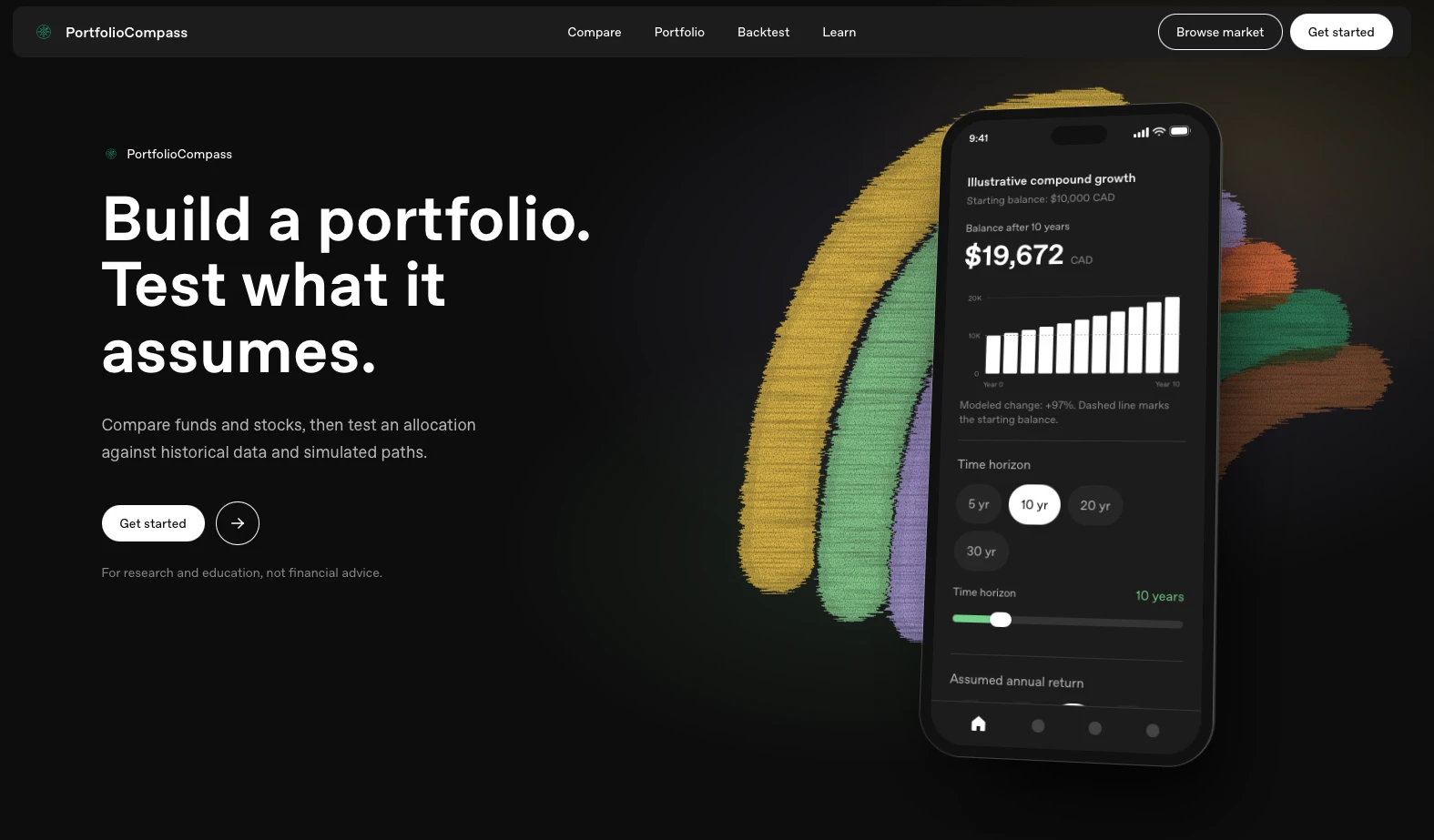
A free planning tool for Canadians who have just opened a TFSA: check contribution room against CRA limits, compare stocks and ETFs on fees, yield and history, build a portfolio, and test how it would have held up.
- Backtesting (Compass Lab): rule-based and coded strategies over daily bars, with next-bar-open fills, slippage and commissions, dividends and rebalancing. Reports CAGR, volatility, Sharpe, Sortino, Calmar, max drawdown, beta, alpha and turnover.
- Overfitting checks: every result splits the first 70% and last 30% of history, a walk-forward test refits the rule year by year, and the app warns when many variants have been tried.
- Risk simulation: Monte Carlo paths from a portfolio's own covariance, with reshuffle, resample and randomized modes and reproducible seeds.
- Valuation: a DCF with WACC built from SEC filings, a regression beta against the market, and readiness checks that refuse to value a company when the inputs are not there.
- Portfolio construction: a budget-aware allocator for stock and bond mixes across risk profiles, total return by default, and CAD/USD handled with Bank of Canada FX.
Case study: a 200-day trend filter on SPY from 2005 to 2026 cut maximum drawdown from 55% to 26%, and the benefit disappeared on the hold-out period from 2020. The write-up covers why that result might be wrong.


A Toronto housing field guide: an interactive map of real City planning and construction data. Built for Hack the Valley 11.
|
A small transformer trained from scratch to do arithmetic, with no calculation at inference and evaluation on held-out problems.

|
Native macOS image analysis on Apple Silicon, with every module labelled by how far it can be trusted.

|
An open userspace driver for the DisplayLink Ridge dock on macOS, written in C.

|
Import and export Maya scenes (.ma / .mb) in Blender.
|
Apple's LiTo image-to-3D model running fully on-device on a Mac.
|
Finance: backtesting · Monte Carlo simulation · DCF and WACC · factor beta · portfolio optimization · SEC EDGAR filings · TFSA rules


🎹 Off the clock I learn songs on the piano.