




Mechanical engineer turned physical oceanographer. I recently finished my PhD at Duke University, where I studied how waves lose energy over very rough coral reefs and how to represent that bottom friction in wave models. I'm based in Santa Barbara, CA.
I care about making scientific models trustworthy and affordable to run: testing every change carefully and getting the same answer on any machine.
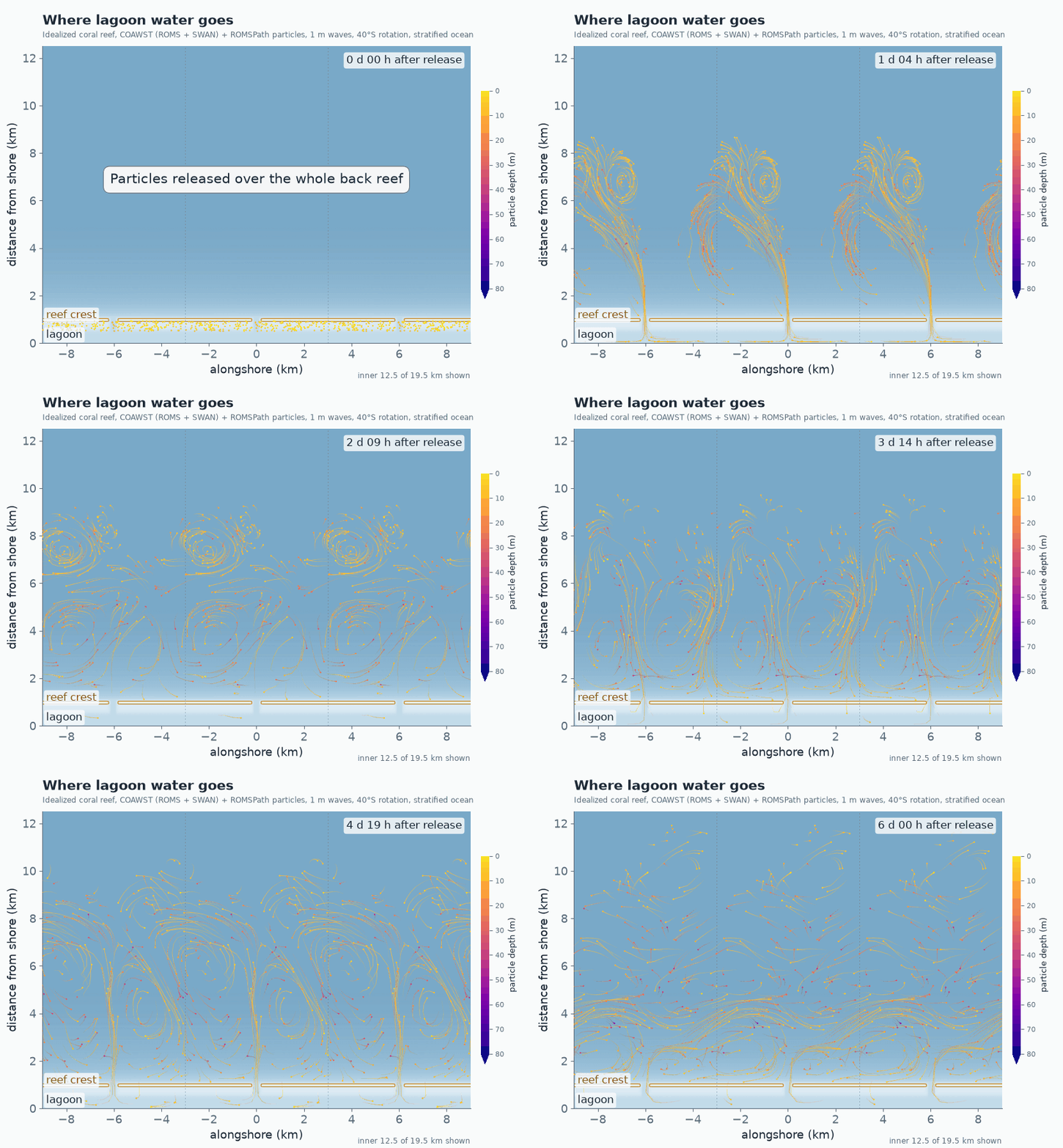
- Coupled wave and circulation modeling (COAWST, ROMS, SWAN) and particle tracking (ROMSPath)
- Testing, extending and speeding up large Fortran model codes
- Reproducible builds in containers (Docker, Apptainer) with automated checks in GitHub Actions
- Ensemble runs on Google Cloud (Compute Engine, Cloud Batch, Spot machines) and HPC (512-core runs on SDSC Expanse)
- Bathymetry merging, satellite imagery analysis, and field data from ADCPs and pressure sensors
- Python, MATLAB, Fortran, C/C++, MPI, Linux/bash
- coawst-cloud: a containerized build of COAWST v3.9 for running coastal ocean ensembles on any machine or on Google Cloud. It adds 29 documented and tested patches, fixes and extensions I developed while taking COAWST into periodic, vegetated reef setups, which I plan to offer upstream. Results are bit-identical on Intel and AMD, restarts are exact so long runs can use Spot machines, and the coupled reef case runs 1.7x faster.
- idealized-reef: a family of idealized coral reef and island simulations (canopy, stratification, solar heating) tested in more than 100 runs, with a lab notebook entry for each. A simulated day costs about $0.15 on Spot machines.
- ROMSPath: my fork of ROMSPath (Hunter et al., 2022), a particle tracking model for ROMS. I added periodic boundaries for idealized reef domains, along with timing and grid fixes checked against a test case with an exact answer, and made it 29 to 43% faster. Each change is its own commit so it can be offered to the original authors.
I'm open to roles in ocean and coastal modeling, coastal hazard and flood risk, climate research, and ML for weather and climate. LinkedIn