


A free, standalone skill that stops every subagent from running on your biggest model.
By default, Claude Code hands every subagent the model you have selected for the session. So
when a task fans out into nine agents, all nine run on Fable 5.1 (or Opus, or whatever you
picked) — the four that translate a messages.json file cost the same per token as the one
that designs the architecture. This skill makes the split explicit before anything launches:
the model is picked by the type of task, never by the importance of the project.
☕ If this saves you time, buy me a coffee.

Or in USDC. Send USDC only and only on the network shown; on any other network it is lost with no way to recover it.
| Network | USDC address |
|---|---|
| Solana | 5n6Gfosk7SdwbvdtE9xiLWpcGPBBBGDZYRfAkWyCk86g |
| Ethereum (ERC-20) | 0xe176866f9d7fdb498e0d4a983d3e34d84dcd6bfc |
| Type of task | Examples | Model · effort |
|---|---|---|
| Mechanical | translations of fixed strings, listing, counting, measuring, running a script and reporting the output, checking that a manifest parses | small (e.g. Haiku) · low |
| Bounded analysis | summarizing a module, mapping dependencies, writing tests from a clear spec, one mechanical change across many files | mid (e.g. Sonnet) · medium |
| Judgment | architecture, writing the code that decides how something works, choosing between options, the final review, anything that ships | the session's model (e.g. Fable 5.1, Opus) · high |
Before any of that it asks the cheaper question first: should this be delegated at all, and how many? The default is no, and the count starts at zero — most work is inline work.
Plus four guardrails the skill enforces: the final reviewer never gets cheapened; a small agent that fails moves the task up a tier instead of being retried; fewer agents beat more agents, and no agent exists just to double-check another's conclusion; and every run declares its split before launching and reports the measured spend after — or says "not measured". No invented savings.
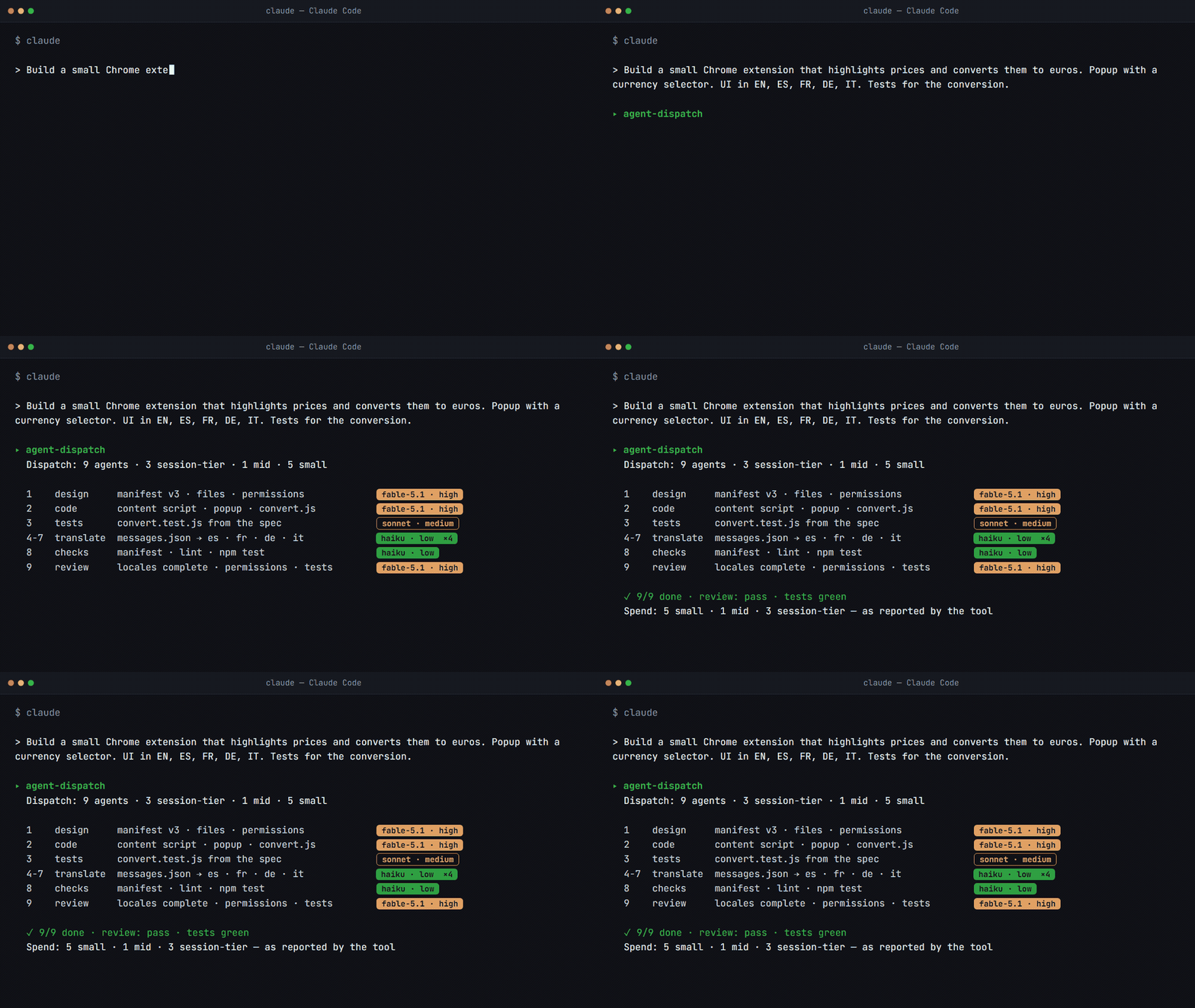
Build a small Chrome extension that highlights prices on any page and converts them to euros. Popup with a currency selector. UI in English, translated into Spanish, French, German and Italian. Tests for the conversion.
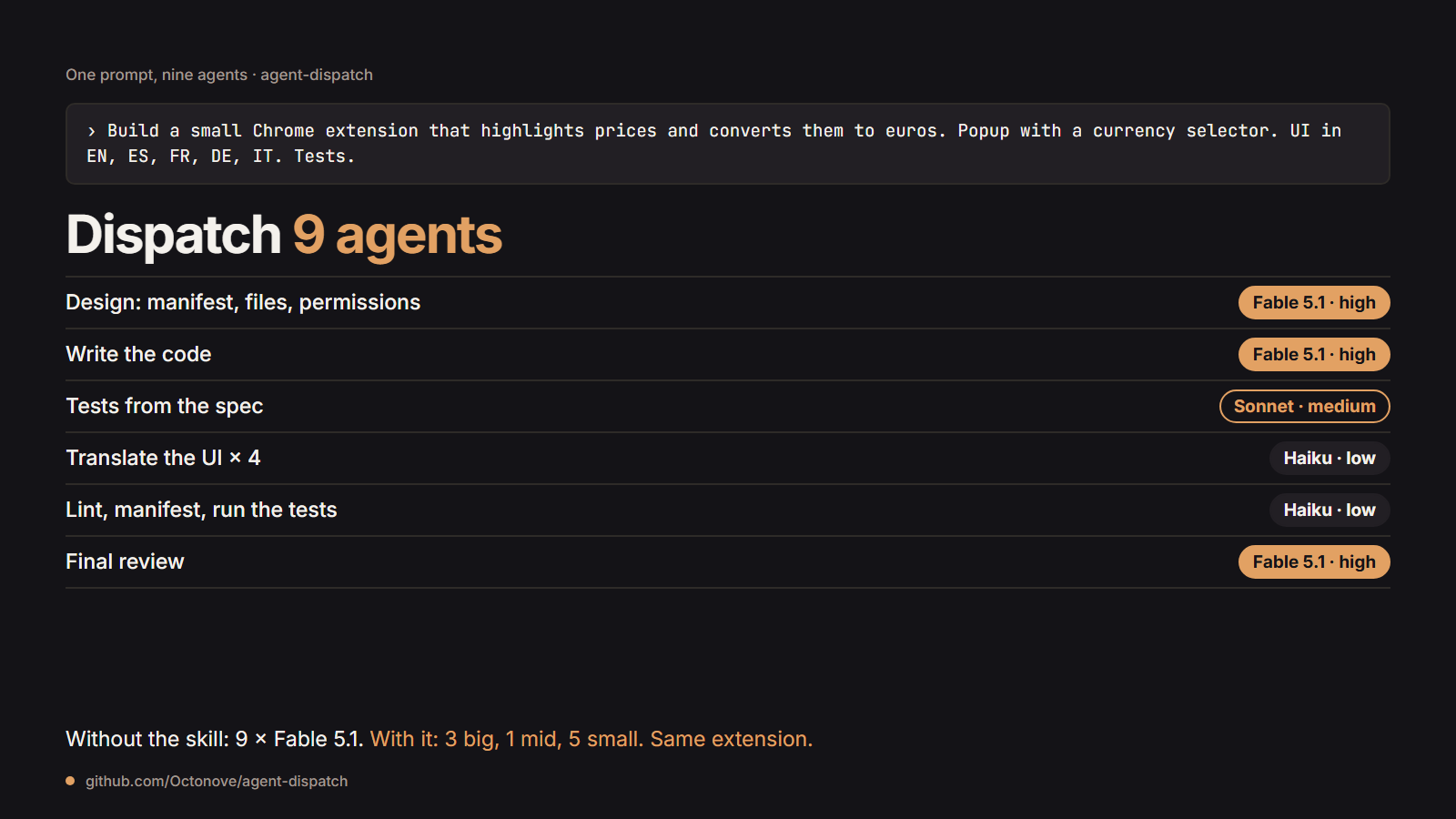
| # | Subtask | Model · effort |
|---|---|---|
| 1 | Design: manifest v3, files, permissions, how content script and popup talk | session model · high |
| 2 | Write the code: content script, popup, service worker, conversion module | session model · high |
| 3 | Write the conversion tests from the spec | mid · medium |
| 4–7 | Translate messages.json into ES, FR, DE, IT — one agent per language |
small · low |
| 8 | Validate the manifest, run lint and the tests, report the output verbatim | small · low |
| 9 | Final review: locales complete, permissions match the code, tests green | session model · high |
Without the skill: 9 agents on the session's model. With it: 3 on the session's model, 1 on
the mid model, 5 on the small one. Same extension. The judgment stayed where it matters.
The full walkthrough, with the briefing each agent receives, is in
examples/chrome-extension.md.
Claude Code — as a global skill (applies in every project):
mkdir -p ~/.claude/skills/agent-dispatch
curl -fsSL https://raw.githubusercontent.com/Octonove/agent-dispatch/main/SKILL.md -o ~/.claude/skills/agent-dispatch/SKILL.md
Or per project: put the same file at .claude/skills/agent-dispatch/SKILL.md. Spanish version:
es/SKILL.md. Claude Code loads skills automatically; the description in the
frontmatter is what makes it apply whenever subagents are on the table.
Cursor — copy the body of SKILL.md into a rule (.cursor/rules/agent-dispatch.mdc) with
alwaysApply: true.
Any other client — paste the body of SKILL.md into your system prompt or project
instructions. If the client cannot choose a model per subagent, the skill says so and applies
the rest (whether to delegate, how many, briefing, declare, measure).
- You get a line like
Dispatch: 9 agents · 3 session-tier · 1 mid · 5 smallbefore anything runs, and the spend the tool reports when it is done. - You do not get a savings number from the skill. It cannot measure what your tool does not report, and it refuses to invent one. Measure your own runs; that is the point.
- Judgment never gets cheaper. If you want everything on Haiku, this is not the skill for you.
- Invokard — 55 skill "cards" for Claude and any MCP client, 9 of them free. This rule is section 1G of The Orchestrator, the free card that routes every request to the right specialist; if you use that card, the dispatch is already inside it.
- CRBRO — an open-source MCP server that gives your AI persistent memory: neurons, sessions and a search index on your own disk, no account. It is where the measured spend of each run ends up when I want to compare weeks.
MIT — do what you want with it, keep the notice. Built by Octonove.