






I study how intelligent systems reason — from the symbolic structures of compilers to the emergent cognition of large language models. The through-line is that reasoning has a shape, and that the shape can be designed: a type system, an instruction set, and a system prompt are all ways of constraining what a machine is allowed to conclude.
MSc in Artificial Intelligence & Robotics at UniCam. The work draws on mathematics and formal theory, cognitive science, psychology, and social theory — not as decoration, but because binary analysis needs adversarial psychology as much as it needs formal semantics, and because context engineering turns out to be a question about how meaning gets constructed from frames. A deep love of mathematics underlies all of it.
Concretely, that means type theory and formal verification on one side, and on the other the reading that makes adversarial systems legible: Foucault on power and knowledge, Bentham's panopticon on surveillance, Weber on rationalisation, Le Bon on collective behaviour, Malatesta on decentralised organisation. Legal reasoning belongs in the same list — precedent and interpretation are a working model of rule-based inference under ambiguity.
| Area | Question | |
|---|---|---|
| 01 | Neurosymbolic AI Reasoning mechanisms in LLMs, context engineering, and the integration of symbolic structure with neural learning. Less about scaling models than about the machinery that makes their conclusions inspectable. |
How do machines think? |
| 02 | Languages & Compilers Formal language theory, type systems, virtual machine architecture, and the mathematical foundations of computation — from lexing and parsing through IR design to runtime systems and bytecode. |
How do we translate intent into execution? |
| 03 | Malware & Binary Analysis Static and dynamic analysis, reverse engineering, and program behaviour at the lowest level: PE/ELF internals, disassembly, detection signatures, and memory forensics. |
Where intent meets implementation. |

A prompt is an operator, not a key. You don't retrieve the right answer by finding magic words — you construct it, section by justified section, the way you build a circuit.
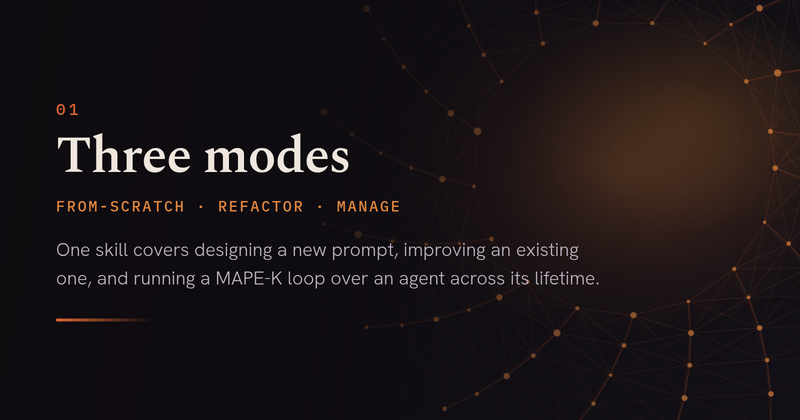
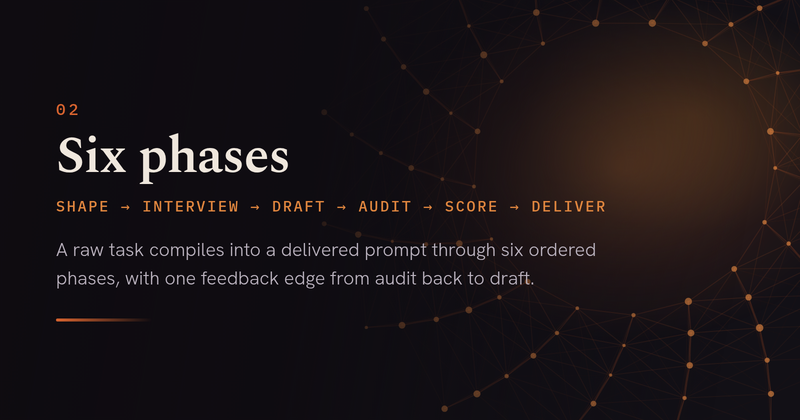
Prometheus is a build-time meta-prompting framework for LLM agents: you describe an intent, and it engineers the artifact end to end — a system prompt, a full agentic loop, or a multi-step workflow. It works across seven structural prompt shapes and three modes, and every artifact it produces ships with a runnable verifier defined over three layers — static properties of the artifact, single-run properties of one output, and cross-run properties visible only across many, which is where agent regressions hide. It runs entirely at build time, with no build step and no dependencies, and every technique is traced to a primary source.
|
|

|
Repository · Website · Documentation
Ordered by stars. Counts are live.
| Project | What it is | Language | Stars |
|---|---|---|---|
| LC3VM | A complete LC-3 virtual machine in C, with a simple operating system. | C |  |
| WebCat | Automated discovery and classification of website content through unsupervised learning. | Python |  |
| Computational Fields | Interactive simulator for aggregate computing and self-organising programs: field calculus, building blocks, real-time visualisation. | Python |  |
| MapyReduce | Lightweight, extensible library for MapReduce-like jobs in Python. | Python |  |
| Logo4J | Logo language interpreter in Java, as both a GUI and a console application. | Java |  |
| RCC Simulator | Agent-based model of renal cell carcinoma with glucose sensing, sex-stratified treatment response, and Bayesian optimization. | Python |  |
| NEOS | Neural Field Operating System: a shell-like command interface for running simulated neural field dynamics on an LLM as a virtual machine. | HTML |  |
| DMS | Drive Malware Scan: malware detection and forensic analysis for Tsurugi Linux. | Shell |  |
| Parkinson Repast Kit | Multi-agent based model simulating Parkinson's disease in Repast Simphony. | Java |  |
| Drone Rescue SAR | Stigmergic multi-drone search & rescue on ROS 2 and Gazebo: pheromone-guided coverage, victim fusion, task auctioning. | Python |  |
What I actually reach for, by area.
AI & agents: Python · PyTorch · Transformers · Claude Code · Claude API · LangChain · LangGraph · Hugging Face
Systems & languages: C · C++ · Java · Haskell · Assembly · Linux · LLVM · Flex/Bison · ANTLR
Binary & forensics: Ghidra · IDA Pro · x64dbg · Volatility · YARA
Interested in neurosymbolic AI, reasoning systems, compiler theory, or the intersection of computation and cognition? Get in touch.