
Figure Forge Studio is a compact, browser-based 3D character customizer. It started as an interface experiment and is published as a small open-source toy for artists, developers, students, and anyone curious about Three.js.
Everything needed for the demo character—geometry, hair, and textures—is
embedded in index.html. There is no build step, backend, account, or data
collection.
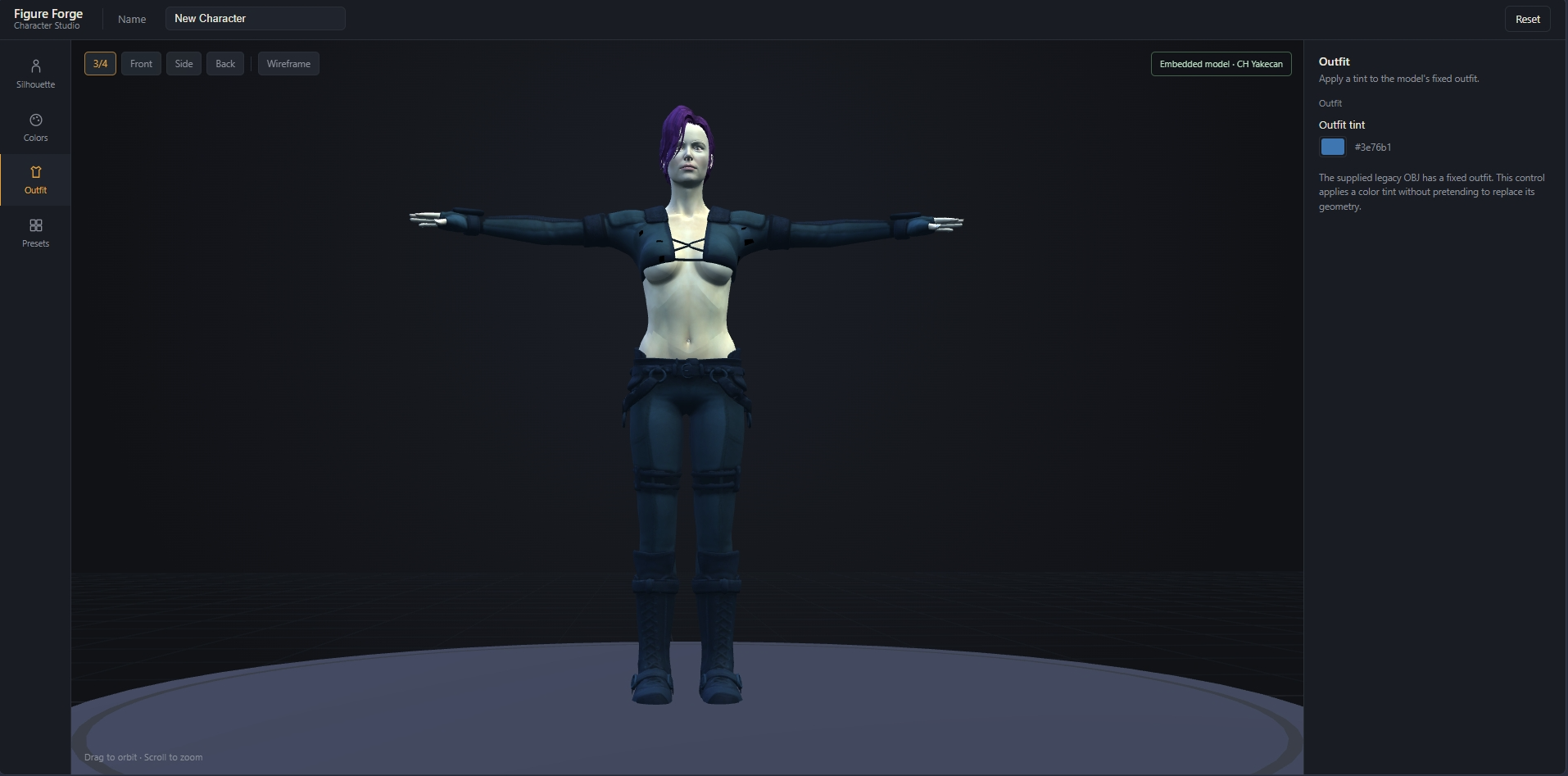
- Real textured OBJ character rendered with Three.js
- Height, build, and shoulder-width adjustments
- Skin, hair, eye, and outfit color tints
- Four starting presets and session-only custom presets
- Front, side, back, and three-quarter camera views
- Orbit, zoom, and wireframe inspection
- Application-neutral JSON configuration export
- Single-file application that can be opened locally or hosted on GitHub Pages
Download or clone the repository and open index.html in a current desktop
browser. An internet connection is required to load Three.js from cdnjs.
You can also serve the folder locally:
python -m http.server 8000Then open http://localhost:8000.
- Create a new GitHub repository.
- Upload the contents of this folder to its default branch.
- Open Settings → Pages.
- Select Deploy from a branch, choose the default branch and
/ (root), then save.
No build action is required.
.
├── .github/workflows/check.yml  # Lightweight repository validation
├── scripts/validate.mjs         # Checks embedded geometry and textures
├── index.html                   # Complete application and embedded assets
├── README.md
├── LICENSE                      # MIT license for the application code
├── THIRD_PARTY_NOTICES.md       # Three.js and character-asset notices
├── CONTRIBUTING.md
└── CHANGELOG.md
The included character is a legacy static Poser OBJ, not a modern skinned avatar. It has no browser-ready skeleton or morph targets. Figure Forge Studio therefore changes supported overall proportions and material tints; it does not claim to reshape facial features, pose limbs, replace clothes, or export a new 3D mesh. Those features would require a rigged glTF/GLB asset with morph targets.
Session presets are kept in memory and disappear when the page is closed. Use the JSON export if you want to retain a configuration.
Figure Forge Studio was prepared by Andreas Holzer with development assistance from OpenAI Codex.
The embedded character arrived in the source collection under the internal labels “CH Yakecan” and “Danation.” The supplied archive contained no named author, copyright holder, license filename, or source URL. Those labels are preserved throughout the project so the asset is not presented as anonymous or newly authored. See THIRD_PARTY_NOTICES.md for the complete notice.
The application code is available under the MIT License. Embedded third-party material is documented separately and is not relicensed by the code license.