
QuantumPDB (qp) automates generation of quantum mechanical (QM) cluster
models from protein structures: structure preparation, protonation, Voronoi
cluster extraction, TeraChem job setup, and post-processing analysis.
Full user documentation: hjkgrpquantumpdb.readthedocs.io
- Overview
- Installation
- Package layout
- Documentation
- Quick example
- Developer guide
- Areas of active development
- Generated file structure
QuantumPDB turns PDB / mmCIF inputs into ready-to-run QM cluster models for metalloenzyme active sites. Unlike simple distance cutoffs, it builds hierarchical interaction spheres with Voronoi tessellation.
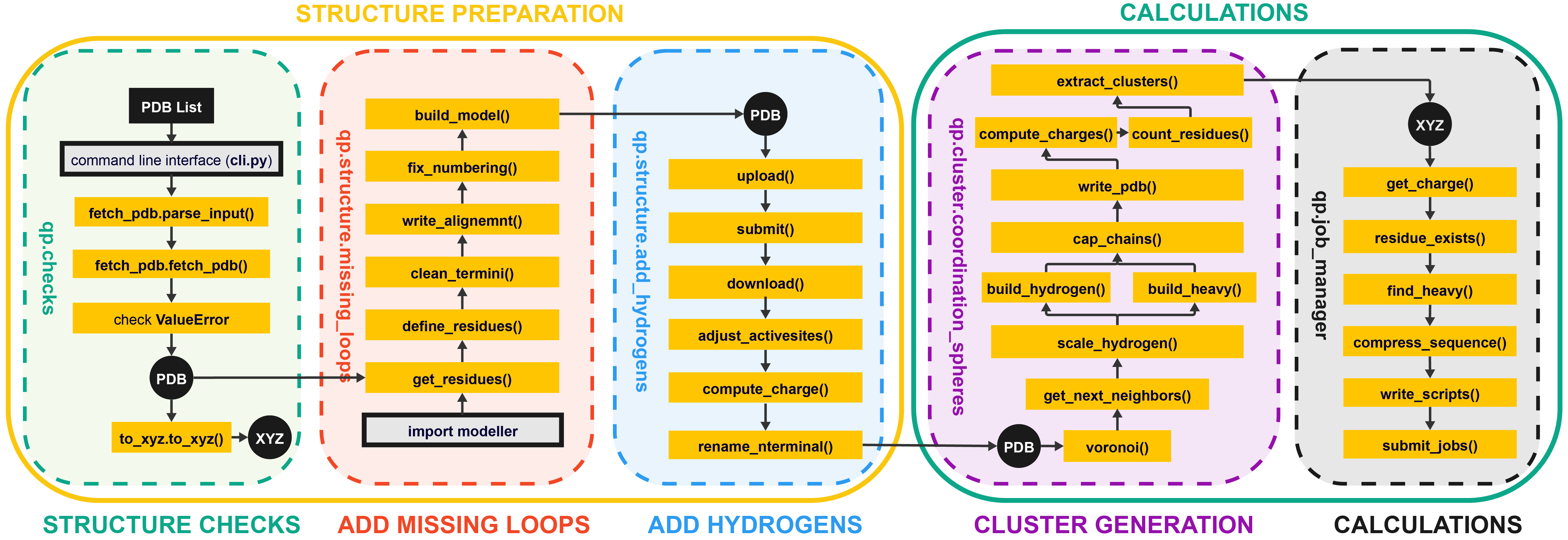
Clone the repository and perform a developer install inside a conda environment:
git clone git@github.com:davidkastner/quantumPDB.git
cd quantumPDB
conda env create -f environment.yml
conda activate qp
python -m pip install -e .
Compatibility is tested for Python 3.10–3.12 (requires Python ≥ 3.8). After
install, the qp CLI is available: qp run, qp submit, and qp analyze.
Modeller needs a free academic license key:
export KEY_MODELLER="XXXX".
├── docs/ # Sphinx / Read the Docs sources
├── example/ # Runnable examples (see example/basics/)
├── config.yaml # Annotated config template (valid keys)
└── qp/
├── cli.py # CLI entry point
├── structure/ # Fetch, mmCIF conversion, Modeller, NHIE-oxo
├── protonate/ # Protoss API and active-site fixes
├── cluster/ # Voronoi spheres and cluster I/O
├── manager/ # TeraChem job creation and submission
├── analyze/ # Job checkup and Multiwfn post-processing
├── resources/ # Bundled assets and helper scripts
└── tests/ # Pytest suite and golden samples
User guides and API docs are hosted on Read the Docs. To build locally:
cd docs
make clean
make html
# open _build/html/index.html
See also docs/README.md for the Sphinx / conda docs environment.
qp run -c example/basics/cluster_only.yamlThis downloads 1OS7, runs Modeller + Protoss, and writes cluster models under
example/basics/output/. See Quickstart
and example/basics/README.md.
git status
git pull
git add -A .
git commit -m "Change a specific functionality"
git push -u origin main
git checkout main
git pull
git checkout -b new-feature-branch
git add -A
git commit -m "Detailed commit message describing the changes"
git push -u origin new-feature-branch
# Open the PR on GitHub, then:
git checkout main
git pull
git branch -d new-feature-branch
git stash push --include-untracked
git stash drop
git pull
Temporary mmCIF support is available via qp.structure.mmcif_to_pdb: local
.cif / .mmcif inputs and RCSB entries without a classic PDB file are
converted to {id}.pdb before Modeller / Protoss / clustering. Multi-character
chain IDs and >3-character residue names are remapped (see
{id}_mmcif_remap.json); structures that exceed classic PDB limits
(>99999 atoms or >62 chains) are skipped with a warning in batch runs.
Center-residue selection accepts either the original or remapped residue names
when a remap sidecar is present. Native mmCIF handling for larger entries is
still planned.
Example layout after qp run (and optionally qp submit) for PDB 1a9s with
output_dir: dataset/:
.
├── config.yaml
├── proteins.csv
└── dataset
    └── 1a9s
        ├── 1a9s_modeller.pdb
        ├── 1a9s.ali
        ├── 1a9s.pdb
        ├── charge.csv
        ├── count.csv
        ├── Protoss
        │   ├── 1a9s_ligands.sdf
        │   ├── 1a9s_log.txt
        │   └── 1a9s_protoss.pdb
        └── A290                      # metal_id directory
            ├── 0.pdb                 # center
            ├── 1.pdb                 # first sphere
            ├── 2.pdb                 # second sphere
            ├── A290.pdb              # combined cluster
            ├── A290.xyz
            └── wpbeh                 # method directory from qp submit
                ├── A290.xyz
                ├── jobscript.sh
                ├── ptchrges.xyz      # if charge_embedding: true
                ├── qmscript.in       # TeraChem input
                └── .submit_record
See docs/output.rst and qp/tests/samples/ for authoritative formats.
Copyright (c) 2024, Kulik Group MIT
Project based on the Computational Molecular Science Python Cookiecutter version 1.1.