

Open embedded C++ for real hardware. We build the software between your firmware and the chips on your board: C++20 chip drivers that never call a vendor SDK, a framework that joins them, and the tools and process that keep them trustworthy. Give a driver a few small functions for your bus and the same code runs on ESP32, STM32, RP2040 or your laptop, where its tests run without hardware. MIT licensed.
Kokeb (ኮከብ) means "star" in Amharic.
Portal: https://kokeb-labs.github.io/ · Drivers · Handbook · Request a driver
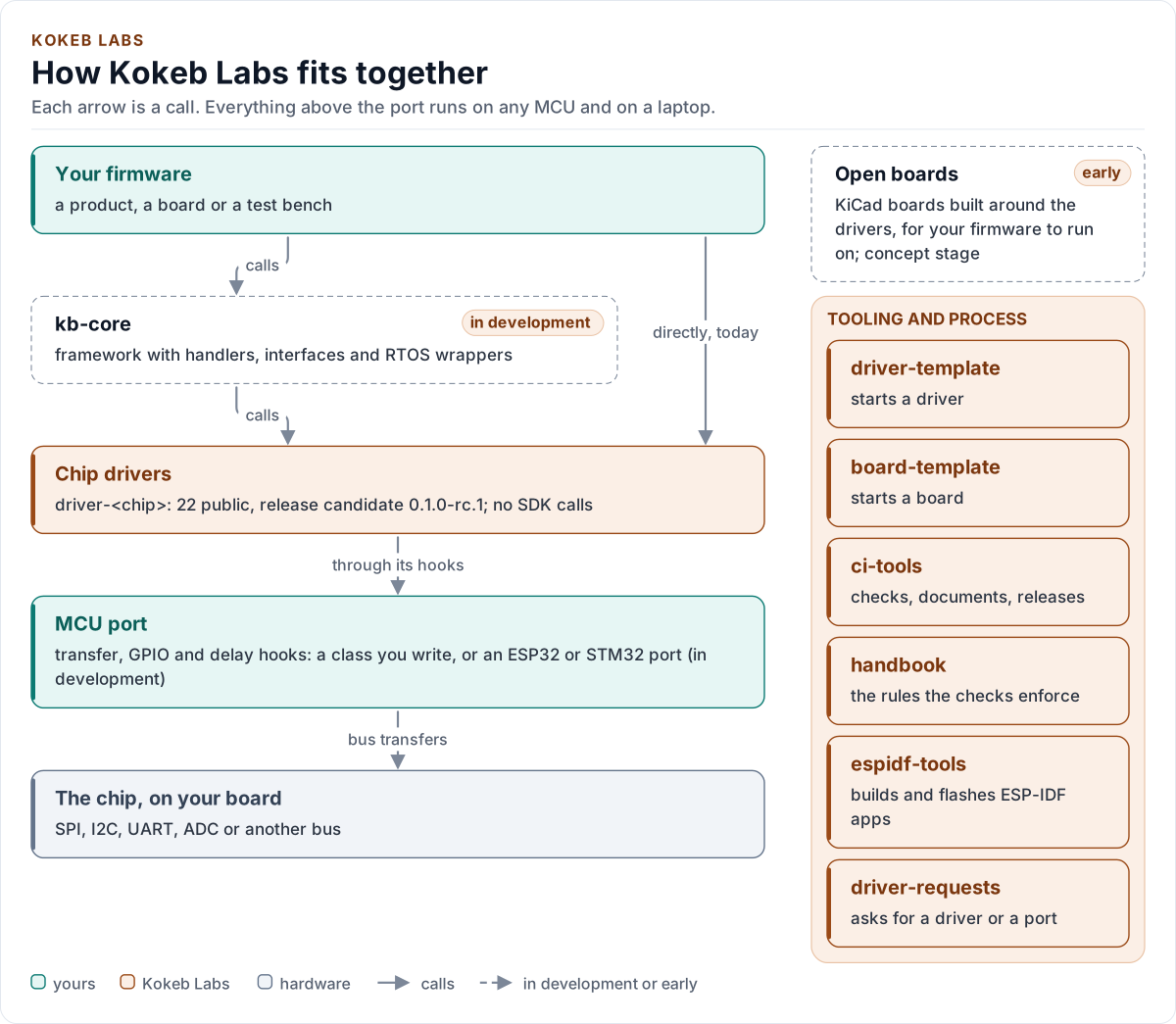
Your firmware calls a driver. The driver knows the chip and nothing about your MCU: it reaches the bus only through
the hooks of a port class, which is a short class you write. Beside that path sits the tooling lane: the templates
start a repository, ci-tools runs the same checks in all of them, the handbook says what those checks enforce, and
the request repository takes the asks for new drivers.
Three organisations, every public repository MIT licensed.
| Where | Project | Role | Status |
|---|---|---|---|
| kokeb-labs-drivers | 22 chip drivers, driver-<chip> |
One header-only C++20 library per chip, from ADCs and encoders to motor controllers. Each has a host example, an ESP32 example and a docs site | Release candidates, v0.1.0-rc.1 |
| kokeb-labs-drivers | driver-requests |
Ask for a driver, a port or a target, or report a datasheet erratum; requests move through the Driver pipeline board | Open |
| This organisation | driver-template |
Start a new driver or library: code, host tests, an ESP32 example, docs and CI from one command | Ready |
| This organisation | ci-tools |
Reusable workflows and the documentation theme and figure kit every repository uses | v1 |
| This organisation | handbook |
Every rule for C, C++, CMake, docs, CI and agents, each with the check that verifies it | Ready |
| This organisation | espidf-tools |
Build, flash and monitor every app of an ESP-IDF project from one app_config.yml |
v1 |
| This organisation | board-template |
Start a new board: record, requirements trace, checks and CI | Version 0 |
| kokeb-labs-open-boards | board-bmp581-breakout, kokeb-libs, kokeb-blocks |
The first board, the KiCad parts library and the circuit blocks boards are made from | Concept |
| Not public yet | kb-core and the ESP32 and STM32 ports |
The framework that joins drivers to interfaces, handlers and an RTOS layer, and the ports that implement the bus hooks | In development |
The portal lists every driver with its chip and bus.
Drivers are built as if they could end up in a safety-classified product, and each says how far it has been checked.
| MISRA C++:2023 | Every pull request runs the MISRA scan; each deviation is recorded with its reason |
| Independent review | A reviewer who did not write the driver reviews it in rounds, and breaks each fix on purpose with mutants |
| Tested and fuzzed | Host tests against a chip model written from the datasheet; a fuzzer corrupts the chip's replies; coverage and complexity gates |
| Release candidates | Every driver ships as a -rc tag first, with its hardware level stated |
| Hardware validation levels | H0 host model only, H1 bench rig run with logs kept, H2 signed off by a hardware engineer. All 22 drivers are at H0 today |
| IEC 62304 | Built so a manufacturer can use a component in software of any safety class, Class C included. It is evidence for their process, not a certificate |
| C++20 today | Every driver is C++20 with extensions off. The standard will move up under a stated policy, not on a date |
Read the details on How we build and in the handbook.
Each board is traced from what people need down to the part on the board and its test results:

Requirements, risks and verifications are data linked by version. Change a need or a chip choice and every
requirement and test that depends on it is flagged in the same pull request. The format and the check live in
board-template. The boards are early: nothing has been built or
verified on hardware yet.
| You want to | Go to |
|---|---|
| Use a driver | The driver list |
| Ask for a chip that has no driver | Request a driver with a link to the vendor's public datasheet; a thumbs-up on an existing request is a vote |
| Write a driver | Start from driver-template |
| Learn the rules | The engineering standard and the handbook |
| Contribute a change | Contributing: branches, commits, the DCO sign-off and the CI gate |
| Report a vulnerability | Privately, as the security policy says |
| Ask a question | Discussions or Support |
Never report a vulnerability in a public issue.