
C99-accelerated Python in-memory Mongo-style rule engine & query matcher with built-in Explain & Trace debugging — powered by mongory-core and verified against mongory-spec.
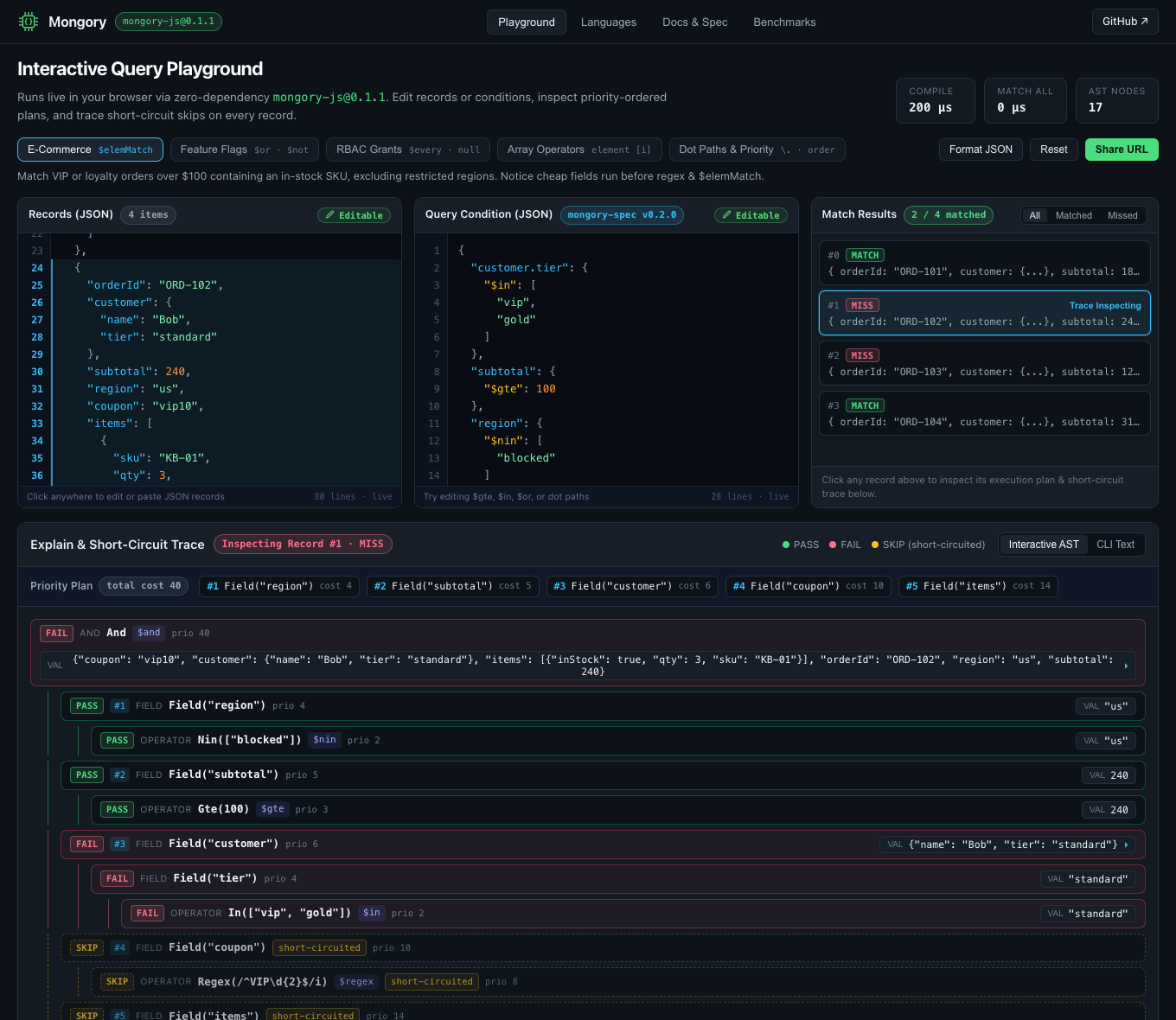
Try the Interactive Playground & Visual Explain/Trace Debugger ↗
Zero database required: Compile a PyMongo-style
dictfilter once into a reusablemongory.Matcherbacked bymongory-core's C99 arena engine and evaluate Pythondicts,dataclasses, or custom objects in memory.
Ecosystem: Interactive Playground ·mongory-go(Go) ·mongory-js(TypeScript/JS) ·mongory-rb(Ruby) ·mongory-core(C99) ·mongory-spec
- Native C99 Engine (
mongory-core): ShallowPyObject*wrapping with arena memory pools and zero runtime Python dependencies. - PyMongo &
re.compileErgonomics: Pass rawdictconditions (including compiledre.Patternobjects), usemongory.compile(cond)or one-shotmongory.match(cond, record), and passMatcherdirectly to Python's built-infilter(matcher, records). - Operator Constants (
mongory.op/mongory.operator): Optional uppercase constants (op.GTE,op.IN,op.OR,op.ELEM_MATCH, etc.) for typo-free conditions with zero overhead. - Built-in
explain()/trace()&explain_tree()/trace_tree(): Inspect priority-ordered execution plans and per-recordPASS/FAIL/SKIPevaluation trees. - Compile-Scoped Extensions & Safety Limits: Custom
converters, customoperators,max_depth(default64),max_nodes(default4096), and full PEP 561.pyitype stubs.
pip install mongoryRequires Python 3.10 or later.
import re
import mongory
from mongory import op

users = [
    {"name": "Ann", "age": 30, "tags": ["py", "go"], "active": True},
    {"name": "Bob", "age": 15, "tags": ["ruby"], "active": True},
    {"name": "Cid", "age": 42, "tags": ["py", "c"], "active": False},
]

# 1. One-shot matching
is_adult = mongory.match({"age": {op.GTE: 18}}, users[0])  # True

# 2. Compile once, reuse across collections / streams
matcher = mongory.compile(
    mongory.and_(
        {"active": True},
        mongory.or_(
            {"tags": "py"},
            {"name": re.compile(r"^b", re.IGNORECASE)},
        ),
    )
)

matched = list(matcher.filter(users))        # [Ann, Bob]
top1 = list(matcher.filter(users, limit=1))  # [Ann]
first = matcher.find_one(users)              # Ann
total = matcher.count(users)                 # 2

# Matcher also implements __call__:
via_builtin = list(filter(matcher, users)) # [Ann, Bob]matcher = mongory.compile({
"name": {op.REGEX: "^A"},
"age": {op.GTE: 18},
"active": True,
})
print(matcher.explain())
matched, trace_str = matcher.trace({"name": "Bob", "age": 15, "active": False})
print(matched) # False
print(trace_str)
# Or retrieve structured dicts for logging / UIs:
plan_tree = matcher.explain_tree()
matched, trace_tree = matcher.trace_tree({"name": "Bob", "age": 15, "active": False})import mongory
from mongory import op
class Money:
def __init__(self, currency: str, amount: int) -> None:
self.currency = currency
self.amount = amount
def compile_money_gte(target: Money):
if not isinstance(target, Money):
raise ValueError("$moneyGte requires Money")
return lambda val, exists: (
exists
and isinstance(val, Money)
and val.currency == target.currency
and val.amount >= target.amount
)
matcher = mongory.compile(
{"price": {"$moneyGte": Money("USD", 100)}, "tags": {op.IN: ["vip"]}},
converters={set: sorted},
operators={"$moneyGte": compile_money_gte},
)
print(matcher.match({"price": Money("USD", 150), "tags": {"vip", "new"}})) # Truepython3 scripts/build_ext.py
MONGORY_SPEC_DIR=../mongory-spec python3 -m unittest discover -s tests -vMIT