


An allocation-free Git toolkit in safe no_std Rust: objects, packs, clients,
and servers. Callers supply repository data, buffers, storage, and I/O. The same
core runs on native systems, bare-metal targets, and WebAssembly.
The library crates use neither std nor alloc. Native CLI startup and the
JavaScript hosting layers have their own memory and runtime requirements.
This is a set of Git building blocks, with a demonstration CLI and host examples.
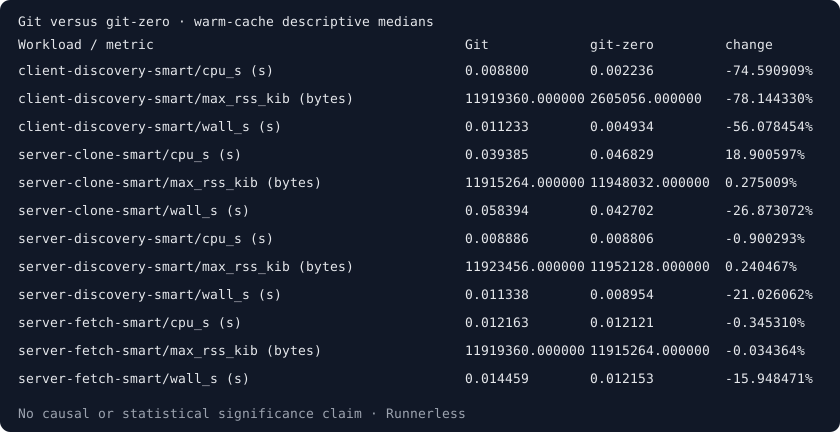
Every main push and PR measures discovery, clone and fetch against pinned Git with matched compression and delta settings. Runnerless processes the original observations and publishes the report; PR runs also receive a benchmark comment. The chart shows warm-cache descriptive medians on GitHub-hosted Linux runners. See collection, retention and manual reruns for the scope.
| Crate | Use it for | API |
|---|---|---|
| git-zero | Combined API with optional client and server reexports | git_zero |
| git-zero-core | Objects, repositories, packs, decoding, and caller-owned caches | git_zero_core |
| git-zero-client | Fetching through a host-provided HTTP transport | git_zero_client |
| git-zero-server | Smart/dumb HTTP serving and opt-in receive-pack primitives | git_zero_server |
| git-zero-rustix | Native file/socket adapters and the git-zero CLI |
git_zero_rustix |
All five crates share version 0.1.0 and require Rust 1.85 or newer.
[dependencies]
git-zero = "0.1.0"
The facade enables read, write, client, and server by default. For a
fetch-only dependency, select just the client:
git-zero = { version = "0.1.0", default-features = false, features = ["client"] }For example, construct a repository from borrowed files and fixed buffers:
use git_zero::{File, Repository, Snapshot};

fn main() -> git_zero::Result<()> {
    let files = [File { name: "hello.txt", contents: b"Hello from git-zero!\n" }];
    let mut tree = [0; 256];
    let mut commit = [0; 512];
    let repository = Snapshot::new(&files, &mut tree, &mut commit)?;
    assert_eq!(repository.object_count(), 3); // Commit, tree, and blob.
    Ok(())
}
The embedding guide shows custom repositories, streaming, validation, and host-owned storage.
- SHA-1/SHA-256 objects, refs, trees, commits, and synthetic snapshots.
- Smart HTTP serving over protocol v0/v1/v2, plus loose and packed dumb HTTP.
- Bounded fetch selection, shallow/history filters, and streamed responses.
- Transport-independent fetching, zlib/pack decoding, and delta resolution.
- Caller-owned selected-pack caches, a native disk backend, and opt-in Worker KV/R2 storage.
- Native file/socket adapters, request/response deadlines, and bounded chunked intake.
- Durable Cloudflare hosting with authenticated push, clone and fetch, atomic ref updates, compressed packs, thin pushes and cold-start recovery.
Snapshot HTTP APIs serve caller-provided read-only repositories. The separate
repository host accepts pushes through our
own no_std Rust Wasm codec and stores data in Cloudflare R2 and SQLite Durable
Objects. Its local tests use actual Wrangler bindings and ordinary Git clients.
Full Linux-scale hosting and deployed resource costs remain unverified; the
host guide records the platform limits and remaining compatibility gaps.
Install the native adapter package, which supplies the git-zero executable:
cargo install git-zero-rustix --version 0.1.0 --locked
git-zero serve 8080
For a source checkout, run from the repository root instead:
cargo run -p git-zero-rustix --bin git-zero -- serve 8080Then, in another terminal:
git clone http://127.0.0.1:8080/repo.git demoThis serves a fixed in-memory snapshot. The git-zero executable also works as
the Git subcommand git zero. The native demo uses HTTP with numeric addresses;
the client library lets the host supply a different transport.
See usage for client
commands, file-backed storage, crate features, and the Worker demo.
- Documentation index
- Current architecture
- Source map for upstream Git developers
- Embedding and repository APIs
- Object formats and decoding
- Development and validation
- Release and package publishing
For plans and project workflow, see the roadmap and contribution guide.
Licensed under MIT OR Apache-2.0.