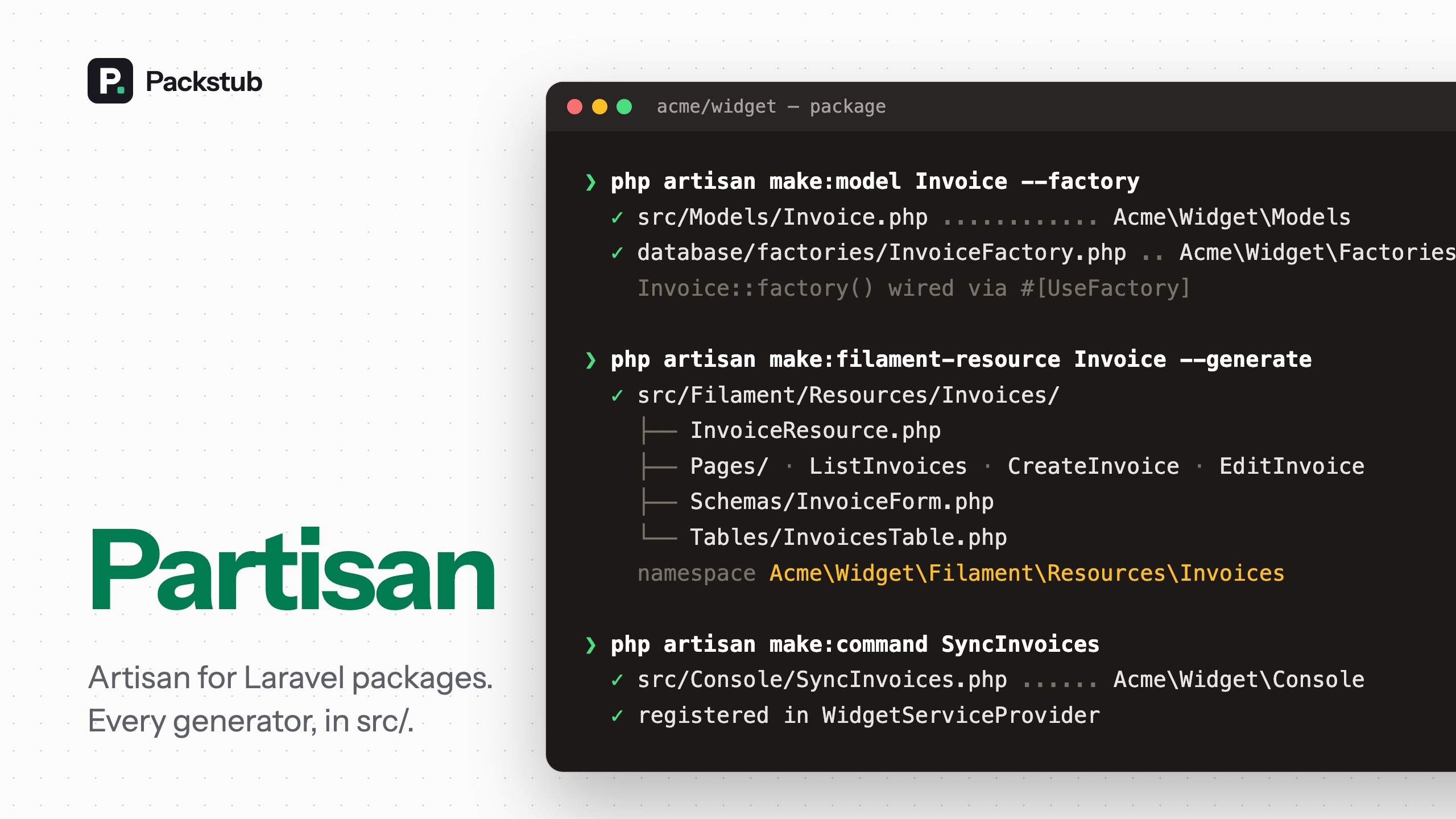



Artisan for Laravel packages. Run every make: generator from your package directory and get files in src/ with your package's namespace — models, commands, migrations, factories, tests, and full Filament resources included.
Built on Orchestra Testbench and Canvas, the tools that already power Laravel package testing. Partisan adds the missing piece: generators that understand your package is the app.
composer require --dev packstub/partisan

vendor/bin/partisan make:model Invoice
# → src/Models/Invoice.php with `namespace Acme\Widget\Models;`Partisan reads your package's composer.json and points the whole generator suite at it:
| Command | Destination | Namespace |
|---|---|---|
make:model Invoice |
src/Models/Invoice.php |
Acme\Widget\Models |
make:command SyncInvoices |
src/Console/SyncInvoices.php |
Acme\Widget\Console |
make:migration create_invoices_table |
database/migrations/… |
— |
make:factory InvoiceFactory |
database/factories/… |
Acme\Widget\Database\Factories |
make:seeder InvoiceSeeder |
database/seeders/… |
Acme\Widget\Database\Seeders |
make:test InvoiceTest |
tests/Feature/… |
Acme\Widget\Tests\Feature |
make:filament-resource Invoice |
src/Filament/Resources/… |
Acme\Widget\Filament\Resources\… |
…and the rest of the make: family (casts, controllers, events, jobs, listeners, mail, middleware, notifications, policies, providers, requests, rules, views, components, enums, interfaces, traits, and more). Generated feature tests extend your package's own tests/TestCase.php when you have one, or Orchestra\Testbench\TestCase otherwise.
Because partisan wraps the Testbench CLI, everything Testbench can do still works — vendor/bin/partisan serve, migrate, route:list, your package's own commands, workbench:install, all of it.
make:model, make:migration and make:factory take a --fields spec, so the model, its migration and its factory come out matching each other instead of as empty stubs:
vendor/bin/partisan make:model Invoice --migration --factory \
  --fields='number:string:unique,total:decimal(10,2)=0,is_paid:boolean=false,status:enum(draft,sent)=draft,notes:text:nullable,user_id:foreignId'
That writes $fillable and a casts() method on the model (total as decimal:2, is_paid as boolean), one column line per field in the migration ($table->decimal('total', 10, 2)->default(0), $table->foreignId('user_id')->constrained()), and a definition() in the factory with a fake per type, fake()->unique() for unique columns and a fake picked by name for email, name, title, slug, url and phone.
The syntax is name:type[(args)][:modifier…][=default], comma-separated. Types are Blueprint column methods and parentheses keep their Blueprint meaning (string(100), decimal(8,2), enum(a,b)); modifiers are nullable, unique, index, unsigned, primary, fullText; = sets the default.
Foreign keys write the relation too: user_id:foreignId adds a constrained column, a user(): BelongsTo method and a related factory in definition(); author_id:foreignIdFor(User) names the model when the column does not; commentable:morphs adds the two columns and a commentable(): MorphTo. On foreign keys the modifiers cascadeOnDelete, nullOnDelete, restrictOnDelete and unconstrained apply. The related class is looked up in your package's model namespace; User with no such class is treated as the host application's user and resolved through config('auth.providers.users.model'), a backslashed name (foreignIdFor(App\Models\Team)) is taken as is, and anything else is written in the package namespace and reported so you can point it at the host model or a config key.
Testbench boots a skeleton Laravel application around your package; Canvas routes every generator through a pluggable generator preset. Partisan registers a preset that maps the generator targets onto your package:
autoload.psr-4→ source path and root namespaceautoload-dev.psr-4→ tests path and namespacedatabase/,resources/→ database and view targetsextra.laravel.providers→ auto-registered, so your package's own artisan commands are available too
The workbench and laravel presets stay available per command (make:model Demo --preset=workbench) when you want to generate into your Workbench demo app instead.
Generated files match your package, not just its namespace: when laravel/pint is installed, every file a generator creates or updates is run through it with your pint.json before you see it, so a declare_strict_types rule, import order or docblock class names come out the way your CI expects. Set PARTISAN_PINT=0 to skip that.
Run vendor/bin/partisan partisan:about to see exactly how your package was mapped.
vendor/bin/partisan is a lot of typing for a tool you reach for constantly. The installer sets up the shortcuts below (and, see AI coding agents, an AGENTS.md section) — each step is a prompt you can decline:
vendor/bin/partisan partisan:installIn scripts and CI (--no-interaction) it only does what you flag explicitly: --link, --alias, --agents.
The installer's first offer is an artisan script in your package root — a two-line stub that forwards to vendor/bin/partisan:
#!/usr/bin/env php
<?php require __DIR__.'/vendor/bin/partisan';
With it, the muscle-memory commands work in your package exactly like in an app:
php artisan make:model Invoice
./artisan make:filament-resource Invoice
A plain PHP file works the same on macOS, Linux, and Windows, and survives archives and checkouts without symlink support — but if you prefer the classic look, a symlink does the job too: ln -s vendor/bin/partisan artisan. Commit the script so every contributor gets it, or let the installer add it to .gitignore if you'd rather keep it personal.
The second offer is a pa shortcut appended to your shell profile (zsh, bash, and fish are detected). To set it up by hand instead, add an alias:
# ~/.zshrc or ~/.bashrc
alias pa="vendor/bin/partisan"
Then, from your package root:
pa make:model InvoiceIf you often work from subdirectories, use a function that finds the nearest vendor/bin/partisan upward instead (this is the variant the installer offers first):
pa() {
  local dir=$PWD
  while [ "$dir" != "/" ]; do
    [ -x "$dir/vendor/bin/partisan" ] && { "$dir/vendor/bin/partisan" "$@"; return; }
    dir=$(dirname "$dir")
  done
  echo "no vendor/bin/partisan here — composer require --dev packstub/partisan" >&2
  return 1
}If your package targets a Filament panel, declare a panel provider (in extra.laravel.providers) whose discovery paths use app_path() — partisan remaps app_path() to src/, so Filament's generators follow along:
$panel->discoverResources(in: app_path('Filament/Resources'), for: 'Acme\\Widget\\Filament\\Resources')Then make:filament-resource Invoice produces the resource, pages, schema, and table classes inside src/Filament/Resources under your namespace.
Add --generate and the form and table come out populated from your model's columns, exactly as in an app. A package has no database for Filament to read, so partisan applies the package's migrations (database/migrations, workbench/database/migrations, and any path a provider or testbench.yaml registers) to an in-memory SQLite connection first; nothing is written to disk and no .env is needed.
After a change, one command answers "does it still boot and is the new thing wired?":
vendor/bin/partisan partisan:checkIt boots the package and reports, one line each: the providers declared in composer.json are registered; the commands and routes the package contributes; Filament panels with their resource and page counts; the package's migrations applied to an in-memory SQLite; pint --test on src/ and database/ when Pint is installed; and whether every class under the package's autoload paths (plus database/factories and database/seeders) can actually be loaded, which catches a factories directory nobody mapped in autoload-dev. The exit code is 1 when anything fails, so it works as a CI step too.
Partisan notices when an AI coding agent is driving it (Claude Code, Codex, Cursor, Gemini CLI, Copilot and friends, via laravel/agent-detector) and switches to output shaped for a model instead of a terminal, following the AXI principles for agent-ergonomic CLIs:
-
Never prompts, no ANSI. Every command runs non-interactively; questions take their defaults.
-
Lists every file it wrote. A generator ends with the files it created and updated, so the agent never spends a turn on
findto learn what appeared:created[6]: - src/Filament/Resources/Invoices/InvoiceResource.php - src/Filament/Resources/Invoices/Pages/CreateInvoice.php - src/Filament/Resources/Invoices/Pages/EditInvoice.php - src/Filament/Resources/Invoices/Pages/ListInvoices.php - src/Filament/Resources/Invoices/Schemas/InvoiceForm.php - src/Filament/Resources/Invoices/Tables/InvoicesTable.php help[1]: Run `php artisan make:filament-resource --help` for this generator's optionsA generator that wrote nothing says so (
created[0]: no files written) instead of leaving the agent to guess. -
Content first.
php artisanwith no command shows the package dashboard — name, namespace, paths, providers, the generators available and the commands to run next — instead of Laravel's 200-line command list.
Set PARTISAN_AGENT=1 to get the same output in your own terminal, or PARTISAN_AGENT=0 to opt out.
The other half is making sure the agent reaches for the generator at all. partisan:install --agents appends a short "Artisan generators" section to your package's AGENTS.md (or CLAUDE.md when that is the only instructions file) telling agents that php artisan make:… works here and to run it before writing scaffolding by hand. Pair it with laravel/pao for agent-optimized Pest and PHPStan output and the whole package loop stays cheap to read.
We measure this with Claude Code driving a real Filament plugin: the same bare task prompt, once with nothing but the package and once with Partisan installed, agent mode on and the AGENTS.md section in place. Nothing in the prompt says how to do the job. Claude Fable 5.1, Partisan 0.4.0 (the model task remeasured on 0.5.0, whose make:model --fields writes the columns, casts, fillable and factory definition from one spec), five runs per task, every run verified afterwards (Pint clean, the resource discovered by the panel, the command registered). Medians, measured 2026-09-16 and 2026-09-17:
| Task | Written by hand | Partisan, agent mode |
|---|---|---|
| Filament resource with form and table, 6 files | 18 turns · 6.3k output tokens · $0.85 | 10 turns · 2.4k output tokens · $0.30 |
| Model, migration, factory and policy | 12 turns · 5.2k · $0.62 | 12 turns · 2.7k · $0.33 |
| Console command, registered in the provider | 12 turns · 2.3k · $0.36 | 8 turns · 1.6k · $0.37 |
| All 15 runs, mean | 14.9 turns · $0.58 | 10.4 turns · $0.36 |
The Filament resource is where the generator pays for itself outright: every agent-mode run was one make:filament-resource Fly --generate --panel=demo, three one-line edits to the schema and table, and partisan:check, four of the five runs within three cents of each other. On the smaller scaffolds the agent edits a generated file instead of writing it from memory, so it spends about half the output tokens for the same number of turns; with --fields the model and migration come out final, and the only edits left are the factory's fake values and the policy's return values. Method, per-run tables and what the transcripts show are in the benchmark write-up.
Partisan needs none for the common case. It honors your testbench.yaml (providers, custom skeleton, migrations, seeders) exactly like the Testbench CLI. Set PARTISAN_DISCOVER=0 to skip auto-registering the providers from extra.laravel.providers.
make:command SyncInvoicesoffers to register the new command in your package's service provider (automatic under--no-interaction, opt out with--no-register). It inserts into an existing$this->commands([...])or spatie-style->hasCommands([...])block — adding the import, never duplicating an entry — and appends a fresh$this->commands([...])block toboot()when the provider has neither.make:model Invoice --factorywires the model to its package factory automatically: theHasFactorydocblock points at yourDatabase\Factoriesnamespace and a#[UseFactory(InvoiceFactory::class)]attribute is added, soInvoice::factory()resolves at runtime with no manualnewFactory(). If a future Laravel stub ships its own factory wiring, partisan detects it and only corrects the namespace.make:providerwrites the class intosrc/Providers; registering it in your package's service provider chain is up to you.
composer testThe suite generates every supported file type into a disposable fixture package and asserts the paths and namespaces, for both Laravel and Filament generators.
MIT