Repository navigation
Home
OOS replaces the software of a Rigol DHO800/DHO900 oscilloscope with a Linux 6.12 kernel and a new scope application written in Rust. It runs from the scope's own SD card, next to the stock system, and you can switch back at any time.
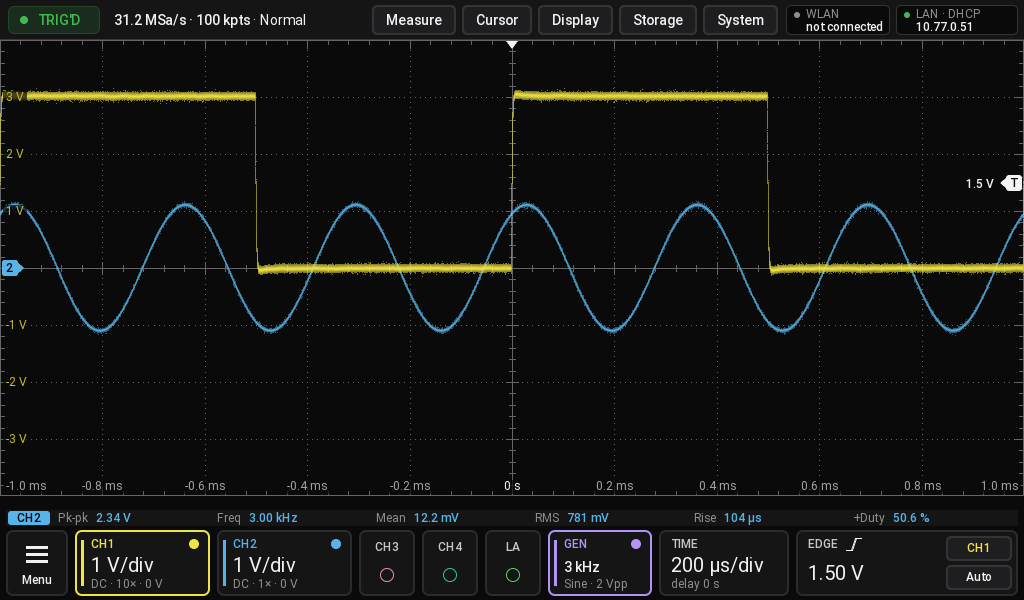
OOS is experimental software. It has run on a DHO924S and, by a user report, on a DHO804; several functions have never run on real hardware (status). Measurements made with OOS are not calibrated to any standard.
- Installing with a second card means opening the scope, and that voids the warranty.
- Back up the original card before anything else. Without that copy, your factory calibration cannot be replaced.
- Connect the scope to a trusted bench network only, never directly to the internet.
Read the Disclaimer before you install. Installing OOS means you accept its risks.
| Page | What it covers |
|---|---|
| Disclaimer | The risks you accept, in full |
| Supported models and features | Which models, what OOS does, what has run on real hardware |
| Gallery | Screenshots of a DHO924S running OOS |
| Try it without a scope | The desktop build and the demo signals |
| Installation | The three ways to install, and which to choose |
| First start and choosing how OOS starts | What the first start looks like, one-shot and persist |
| Daily use | Controls, views, analysers, web remote, files, updates |
| Troubleshooting | What you see, what it means, what to do |
| Going back to stock | Back to the stock system, for one start or for good |
| Building OOS | The kernel, the signing key and the image |
| Development | Where contributors start |
| FAQ | Short answers to common questions |
| Thanks and licences | The projects OOS builds on, and the licences |
This wiki is generated from wiki/ in the repository.
Edits made here in the web interface are overwritten on the next publish. Propose changes with a pull request.